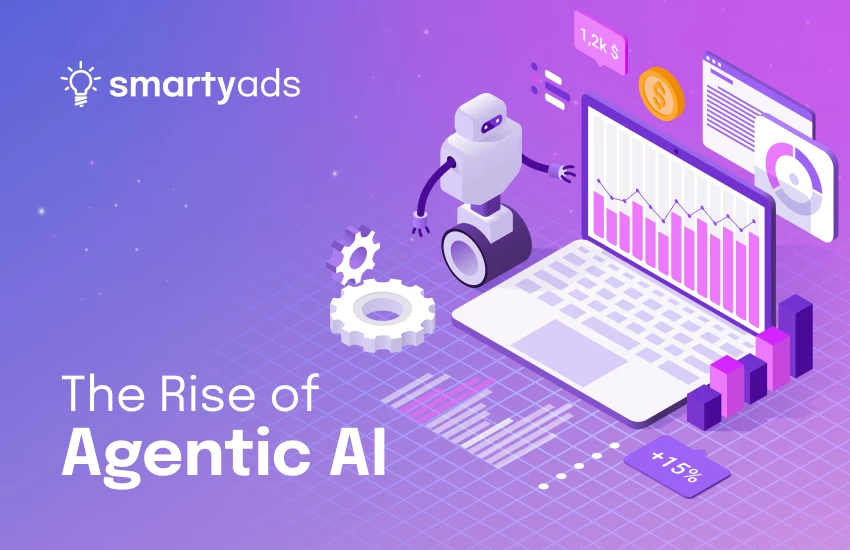
The world of advertising is undergoing significant transformations. A new era of intelligent and responsible technologies is on the rise. One of the most promising developments shaping the industry's future is agentic AI. Unlike traditional automation, agentic AI can go beyond individual tasks by planning and executing sequences of actions toward a defined goal. The level of autonomy depends on the system's capabilities, available tools, and the permissions and safeguards established by its developers.
Agentic AI is attracting growing attention in programmatic advertising, where it could help coordinate tasks across media planning, buying, selling, and campaign management. However, it is still an evolving field, and the extent to which these workflows can be automated varies across implementations. This technology aims to streamline the digital advertising ecosystem and support brand safety, targeting precision, and industry sustainability. The big question now is: what does this mean for the future of advertising?
Sustainability as a continuous trend in digital advertising
It's worth noting that sustainability is becoming a focal point in every industry, and digital advertising is no exception. As the domain generates a significant carbon footprint, more responsible and transparent AdTech solutions are becoming increasingly important.
Now, advertisers, ad agencies, and publishers deal with increasing pressure to reduce their carbon footprint and operate more ethically.
This increased demand for sustainable practices is driving innovation in how media buys are optimized. We are witnessing a clear pivot towards reducing wasteful spending and enhancing ad relevancy.
For instance, Scope3 offers solutions focused on measuring and reducing the environmental impact of digital advertising, including addressing emissions associated with media buying.
AI and agentic systems may help advertising teams analyze data and coordinate decisions across complex workflows. However, using AI does not automatically reduce emissions or eliminate advertising waste. These outcomes depend on the specific implementation and how its impact is measured.
Introducing agentic AI
So you might be wondering what exactly agentic AI is, and why everyone is talking about it? Well, simply put, agentic AI represents an approach in which AI systems can work toward defined goals by planning and carrying out multiple steps, rather than only responding to individual requests.
Traditional AI assistants can help industry professionals retrieve information, analyze data, and generate recommendations. AI agents can go further by using connected tools to execute authorized actions. Some agents still require human approval before acting, while others can complete predefined tasks with less intervention. The distinction depends on their capabilities, permissions, and safeguards.
This allows companies to explore new ways of managing workflows, resources, and programmatic campaigns. For example, an advertising agent could search for suitable media inventory, compare available proposals against a campaign brief, and prepare a shortlist for review. Whether it can proceed to a purchase or modify a live campaign depends on its integrations and authorization.
The advantages of agentic AI for AdTech could be significant. It may allow advertisers to apply algorithm-driven automation that goes beyond simple ad placement. Instead of requiring people to coordinate every step manually, agents could connect different stages of media buying and campaign management. The extent of that automation and its effect on campaign performance needs to be assessed for each use case.
Furthermore, agent-based systems could support brand-safety workflows by helping teams check placements against defined preferences and requirements. However, these capabilities depend on the data, integrations, and controls available to each system; agentic AI alone does not guarantee safer placements or more precise targeting.
From AI Assistants to Agentic Advertising
Not every AI tool used in advertising is an AI agent. There are three useful distinctions:
- AI assistants retrieve and analyze information, summarize reports, and help people make decisions. They do not necessarily take action in advertising platforms.
- AI agents can plan and execute sequences of tasks using connected tools. Depending on their permissions, these tasks might include discovering inventory, comparing media proposals, or preparing campaign settings. Actions involving spending or live campaign changes may require human approval.
- Multi-agent workflows involve multiple agents interacting to complete related tasks. For example, a buyer agent could send a campaign brief to a seller agent, receive available media proposals, and compare them against the advertiser's requirements. The workflow may then pass a selected proposal to the next stage, subject to the appropriate approvals and controls.
This distinction is becoming more relevant as the advertising industry develops standards to help agents work across different platforms and organizations. Two notable developments in 2026 are IAB Tech Lab's AAMP 2.3 and AAMP 3.0 with OpenProposal.
AAMP 2.3: Supporting Production-Ready Agentic Advertising
On July 30, 2026, IAB Tech Lab announced AAMP 2.3, an update to its Agentic Advertising Management Protocols. The release focuses on enterprise deployment, interoperability, privacy diligence, and pricing integrity. It also expands support for integrating agents into existing advertising infrastructure.
AAMP 2.3 introduces mechanisms intended to make agent-driven workflows more reliable, including privacy checks, pricing safeguards, and defined controls around transactions that commit advertising spend. These developments address a key challenge for agentic advertising: enabling automation while maintaining oversight and trust.
The release is an industry effort to make agent-based advertising workflows more practical to deploy. It does not mean that every advertising platform already supports all of these capabilities.
AAMP 3.0 and OpenProposal: Connecting Media Briefs with Proposals
On September 22, 2026, IAB Tech Lab announced AAMP 3.0 with OpenProposal. OpenProposal introduces a standardized, agent-readable format for sellers to represent advertising products and respond to buyers' media briefs. The specification is open for public comment through October 22, 2026.
The goal is to make the process between a request for proposal (RFP) and a potential media-buying commitment easier to handle across compatible systems. Buyer agents can use structured proposals to discover and compare opportunities against a brief, while sellers retain control over how their inventory and advertising products are represented.
For example, an advertiser could provide a brief specifying the target audience, geography, campaign dates, formats, and budget. A buyer agent could compare compatible media proposals against these requirements and identify relevant options. A seller agent could provide a structured response, helping both sides exchange information in a more consistent format. Any subsequent purchase would still depend on the systems involved, their permissions, and applicable approval requirements.
OpenProposal connects this proposal stage with existing industry standards used in media execution, including AdCOM, OpenDirect, and the Deals API. Together, these standards aim to support more connected workflows from media discovery and planning through buying, execution, and reporting.
These developments illustrate how the industry is working to establish common protocols and safeguards for agentic advertising. They represent progress toward interoperability, rather than proof that fully automated, multi-agent media buying is already widespread.
So, what is all the fuss about?
Agentic AI is not another trendy phrase. It represents a developing approach to advertising workflows in which AI systems may be able to plan and carry out multiple connected tasks. Its practical value will depend on how well these systems address real operational challenges, rather than on autonomy alone.
The emergence of standards such as AAMP 2.3 and AAMP 3.0 with OpenProposal highlights the importance of interoperability, reliable data, privacy safeguards, and clear rules for authorizing transactions. These foundations can help agents interact across different systems without requiring the entire advertising ecosystem to replace its existing infrastructure.
Advertisers will continue to rely on established programmatic technologies, while AI assistants and agents may introduce additional ways to analyze information, discover inventory, and coordinate media buying.
Rather than assuming that agentic AI will replace traditional advertising workflows, businesses should consider which tasks are suitable for AI assistance, which could benefit from agent-based automation, and where human oversight remains necessary. The potential benefits must be evaluated against actual implementation capabilities and measurable outcomes.
To wrap up
At SmartyAds, we believe in continuous innovation. Our team is fully committed to staying at the top of technological advancements and following the latest trends in programmatic advertising.
Our feature-rich demand-side platform implements solutions to help advertisers achieve greater precision and better results. For example, our latest feature, Creative Builder, and powerful contextual targeting are designed to facilitate the workflow for our clients, enhance ad engagement, and meet their campaign goals with ease.
Sign up for our DSP and explore how to elevate your advertising strategy today!