

Digital advertising keeps getting more crowded. And more expensive. Publishers now have dozens of ad formats to choose from, each built for a specific goal, placement, and type of user. Advertisers are always hunting for the format that delivers the most for their money. Both sides meet in ad exchanges — where format choice shapes auction prices, fill rates, and campaign results.
Picking the wrong format wastes budget fast. A great video ad shown to someone on a slow mobile connection will frustrate, not convert. A banner sitting below the fold on a text-heavy page gets scrolled past without a glance. Matching ad formats to the right context, audience, and goal is what separates effective campaigns from expensive ones. Global digital ad spend hit $772 billion in 2024. It's projected to grow 8.8% per year through 2027. Format decisions matter more than ever.
What Is an Ad Format?
An ad format is the blueprint of a digital ad. The size, shape, media type, and behavior on screen. Think of it as the container — the format sets the rules, the creative fills it in.
Different ad formats work in very different ways. Some use static images. Others use video, animation, sound, or interactive elements like expandable panels and mini-games. Some blend into the content around them so smoothly that users barely notice. Others take over the screen entirely — by design. The IAB maintains standard specs for advertisement formats so publishers and advertisers can work together without constant technical friction.
For ad exchanges and SSPs, digital ad formats are the core units of inventory. More formats supported means more buyers interested. More buyers means more competition. More competition means higher CPMs.
Types of Ad Formats
Before looking at specific units, it helps to understand the main categories of types of online ads. Each has its own logic. Where it lives. How it works. Why buyers choose it.
Display
Display ads are the foundation of web monetization. Image-based banners and panels placed across websites and apps. This is the format category that built programmatic advertising as we know it. It works best for brand awareness and retargeting — where showing up repeatedly builds recognition. Still the highest-volume category by impression count worldwide.
Video
Video uses motion, sound, and story in ways static formats simply can't match. Digital video ad spending hit $191 billion in 2024 and is projected to reach $338 billion by 2030. And 78% of consumers say they'd rather learn about a product through short video. That makes video inventory increasingly central to publisher revenue.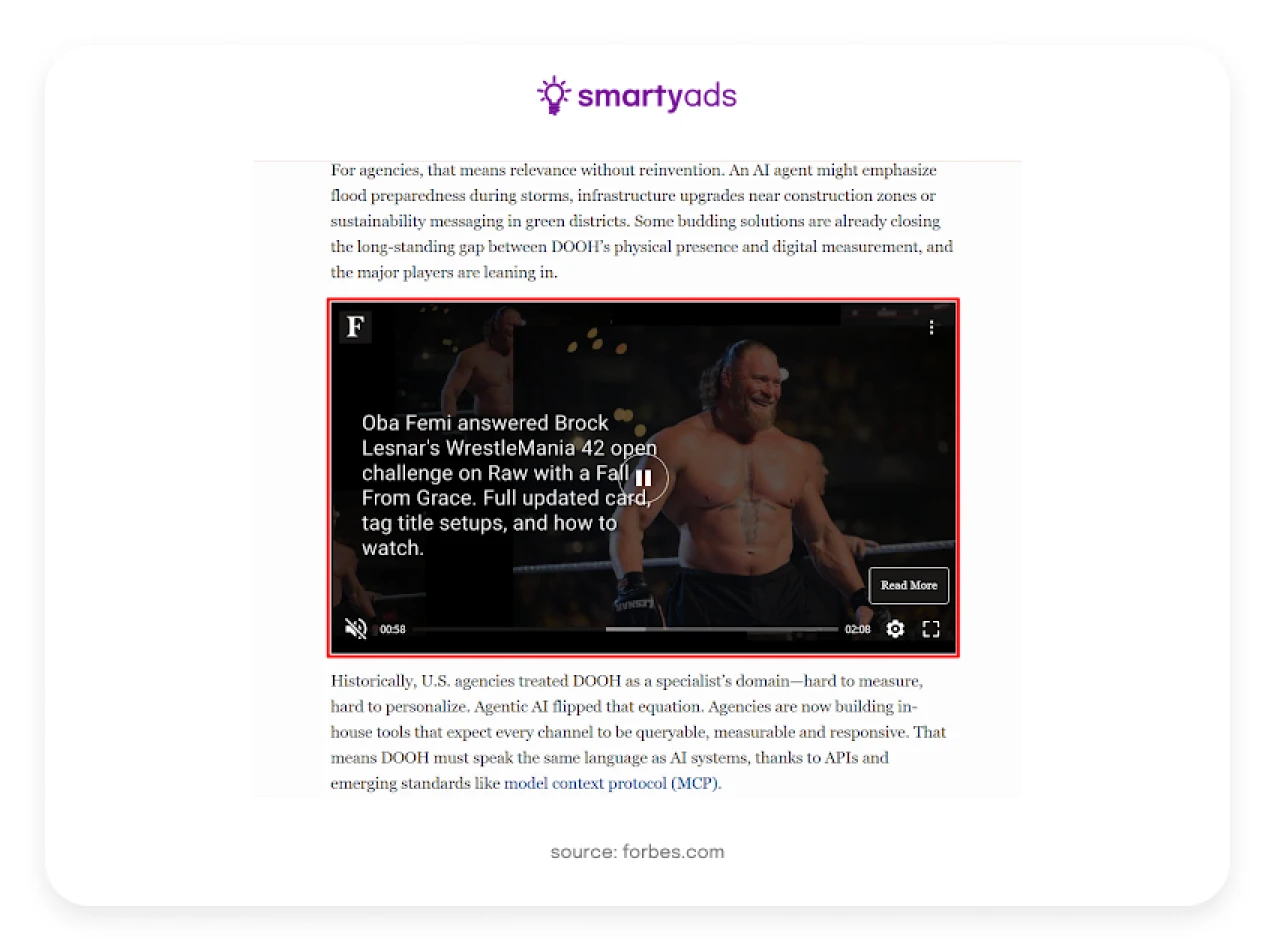
Native
Native ads are built to look like the content around them. Instead of interrupting the experience, they fit into it. A feed item. An article recommendation. This makes them far less vulnerable to banner blindness — the habit users develop of ignoring anything that looks like a traditional ad.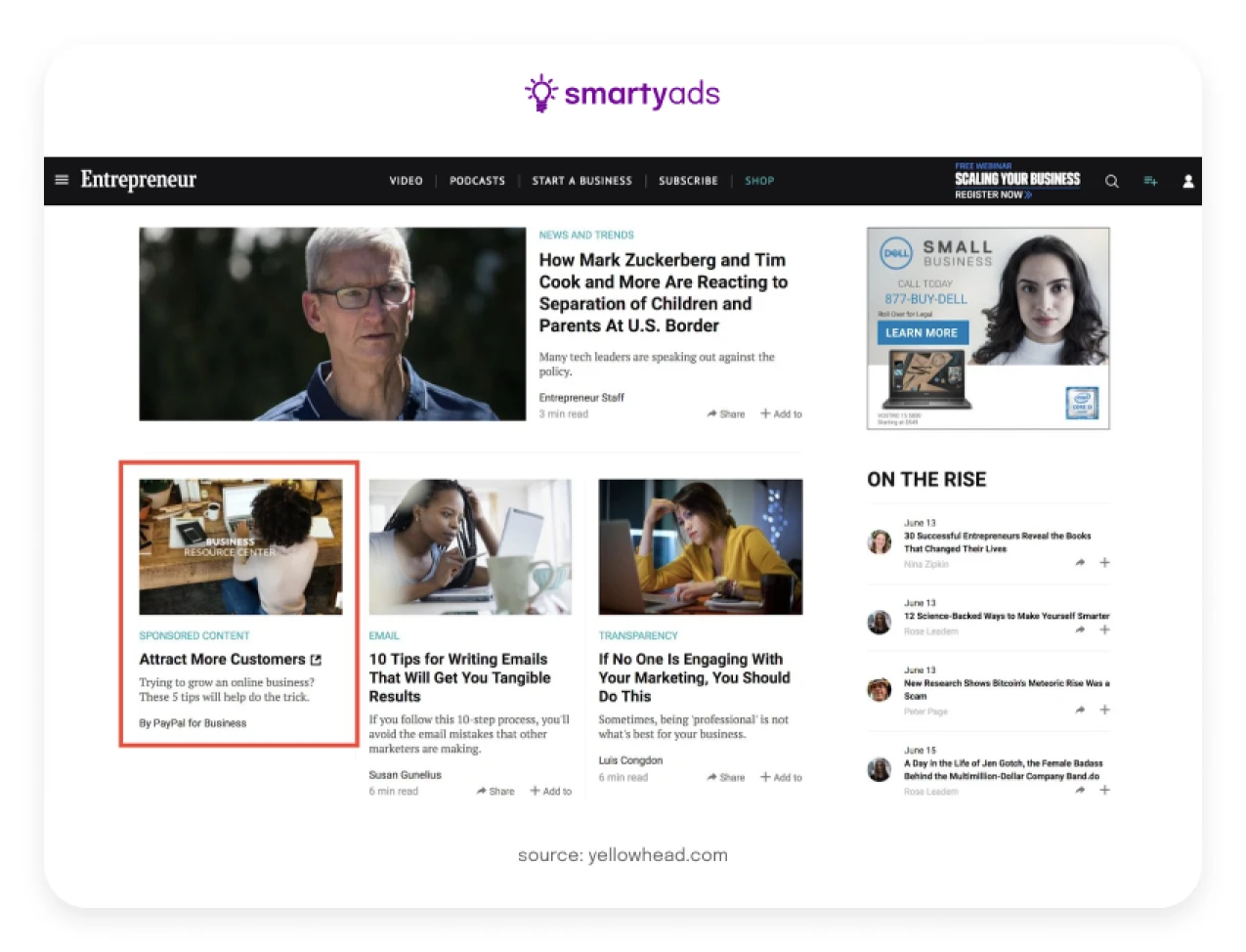
Social Media Ads
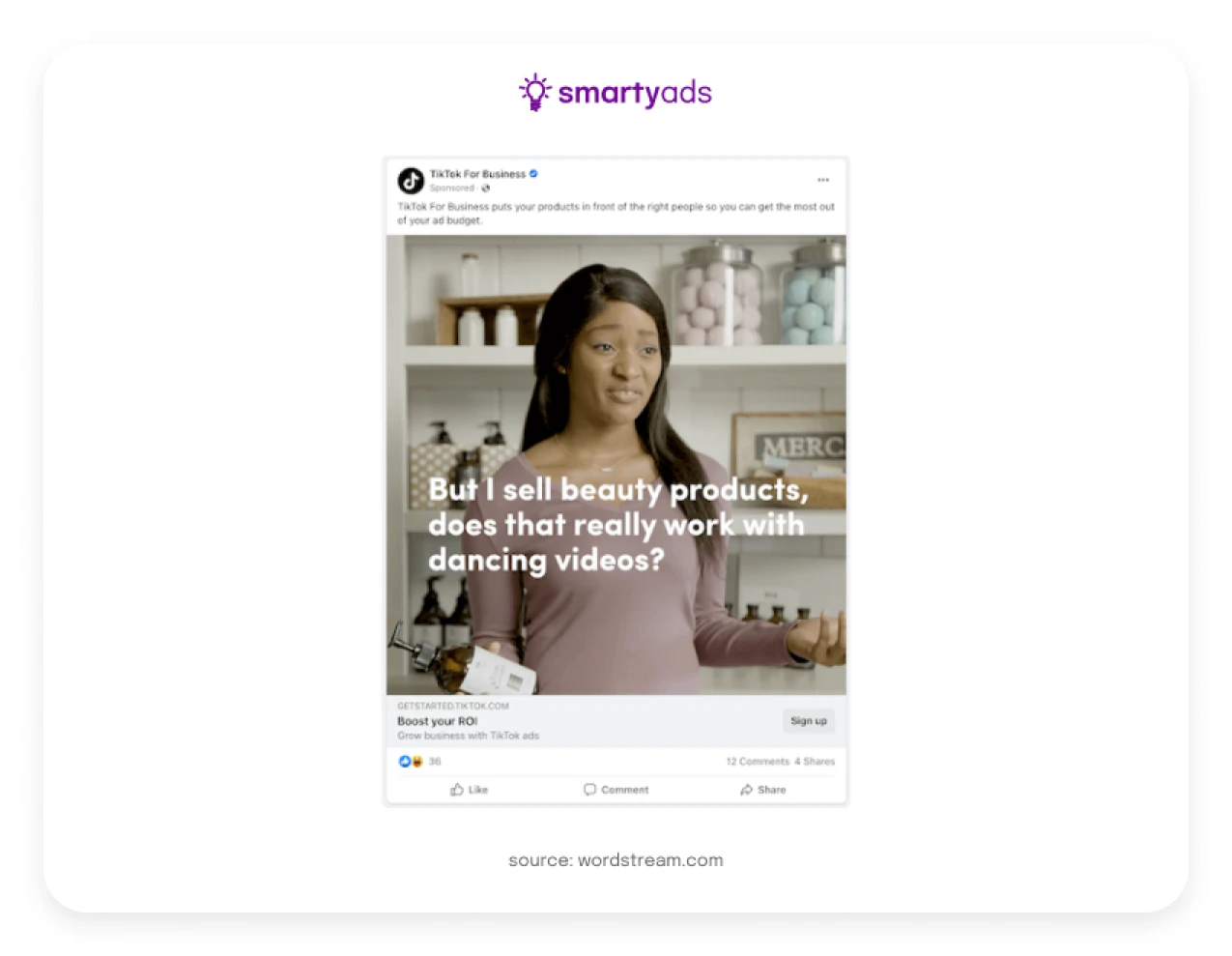
Social platforms have built full ad ecosystems around how their users actually behave. Facebook carousels, Instagram Stories, LinkedIn Sponsored Content, X Promoted Posts — each follows platform-specific rules on size, copy, and interaction. These formats combine precise first-party targeting with units built for scrolling. Global social ad spend is expected to hit $433 billion by 2030. And 76% of consumers say they've bought something after seeing a social ad.
Search Engine Ads
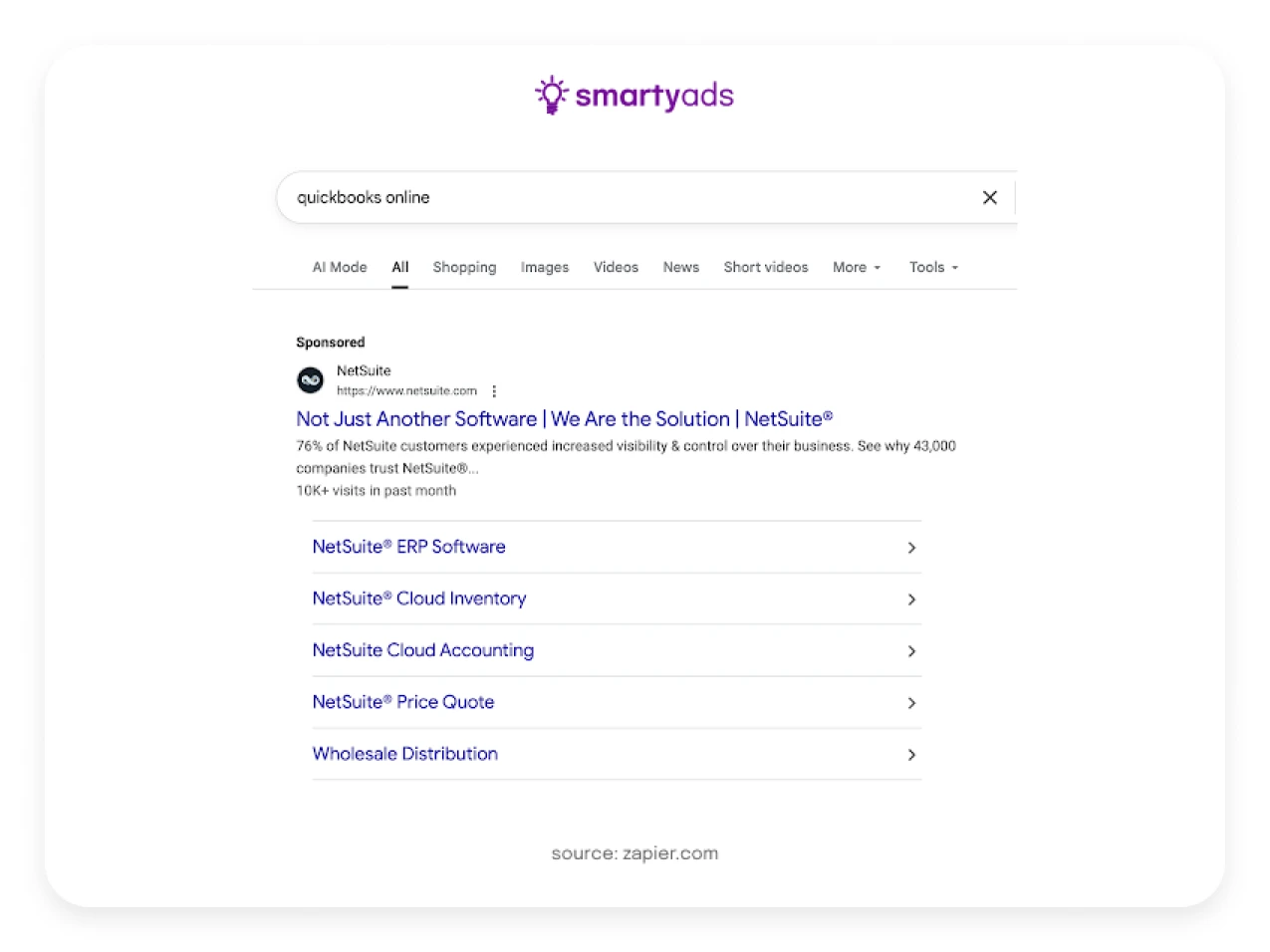
Search ads are text units triggered by keywords. They appear above or beside organic results on Google, Bing, and similar platforms. Intent-driven by design. Someone searching "best CRM software" has already signaled they're close to a decision. For direct-response advertisers, search consistently delivers some of the highest conversion rates across all online ad formats.
Display Ad Formats
Display ads remain the backbone of publisher revenue on the open web. For ad exchanges, a wide range of display inventory is a real competitive edge. More formats attract more buyers. More buyers create more competition. More competition raises prices.
Display Banner Ads
Banners are static or animated image units placed at fixed spots — header, sidebar, or between content blocks. The IAB defines the standard sizes. The leaderboard (728×90), medium rectangle (300×250), and half-page (300×600) carry most publisher inventory. The 300×250 is the most traded unit in programmatic markets worldwide. It fits nearly any layout and draws buyers across every major category.
Some marketers dismiss banners as low-engagement. But they still move enormous volume. Their strength is scale and retargeting efficiency. A user who's abandoned a checkout page three times reacts very differently to a retargeted banner than a cold prospect does. For publishers, banner inventory provides a reliable CPM floor across virtually all demand sources.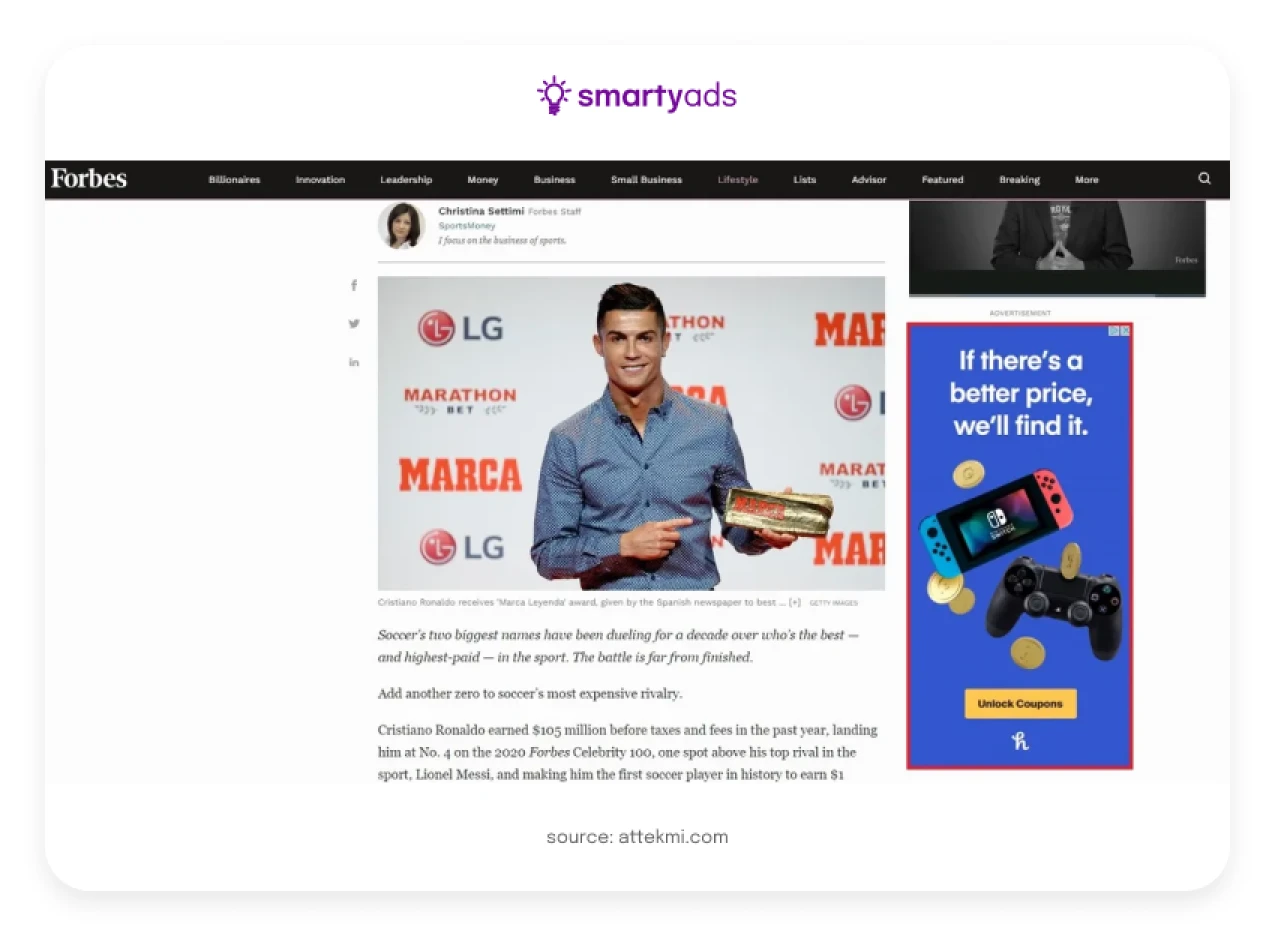
Pop Ads
Pop ads — pop-unders and pop-ups — appear over or behind the current browser window. They take over the screen entirely. That delivers 100% viewability by default. Which makes them effective for direct-response offers where immediate attention is the whole point.
These are aggressive formats. They work best in specific verticals and traffic types. For publishers, they offer strong CPMs where standard display demand is thin. But frequency capping matters. Show pop ads more than once per session and user experience drops fast — without any meaningful revenue gain to show for it.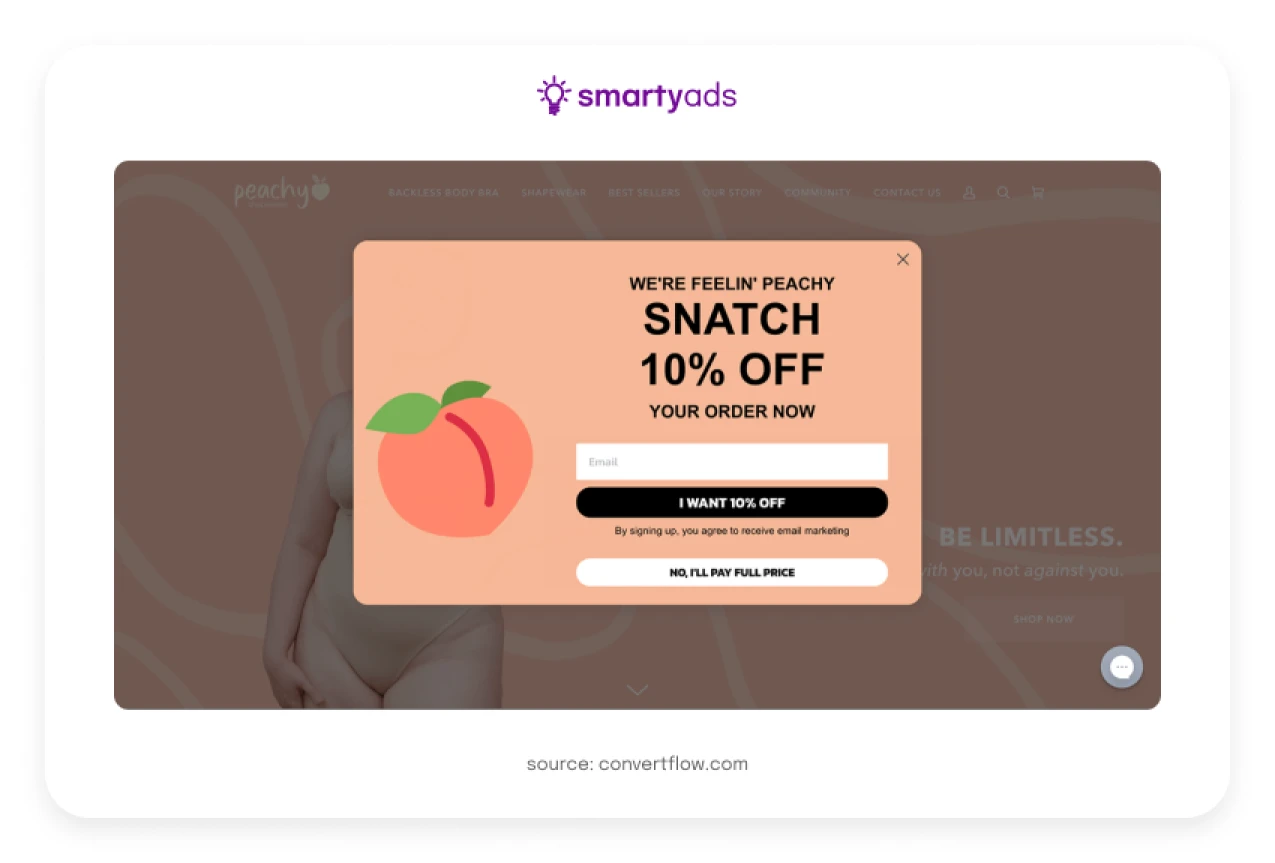
Video Ad Formats
Video is the fastest-growing segment of online advertising formats by spend. Motion, audio, and story give it persuasive power that static formats lack. The global digital video ad market is projected to grow from $187 billion in 2023 to $659 billion by 2030. For publishers, video inventory often commands the highest CPMs in the entire stack.
Here are the main video ad formats:
- In-Stream Video Ads — played before (pre-roll), during (mid-roll), or after (post-roll) video content. The digital equivalent of a TV commercial. Bought on CPM by brand advertisers
- Out-Stream Video Ads — auto-play units embedded in article text or content feeds. No dedicated video player needed. They bring video revenue to publishers without their own video content
- In-Banner Video Ads — video served inside standard banner slots. Publishers without a video player can still earn video-level CPMs
- Auto-Play Video Ads — start playing when the ad scrolls into view. Usually without sound. Viewable completion rate is the key metric
- Interactive Video Ads — include clickable elements, polls, quizzes, or shoppable features. Users engage directly inside the ad
- Skippable and Non-Skippable Ads — skippable pre-rolls let users skip after 5 seconds. Non-skippable units require full viewing and carry premium pricing
- Vertical Video Ads — portrait-format video for mobile full-screen viewing. Dominant in Stories placements across social platforms
Online video ad spending is projected to grow 8% in 2025. Advertisers keep chasing high-attention environments. Well-placed video inventory is exactly that.
Native Ads
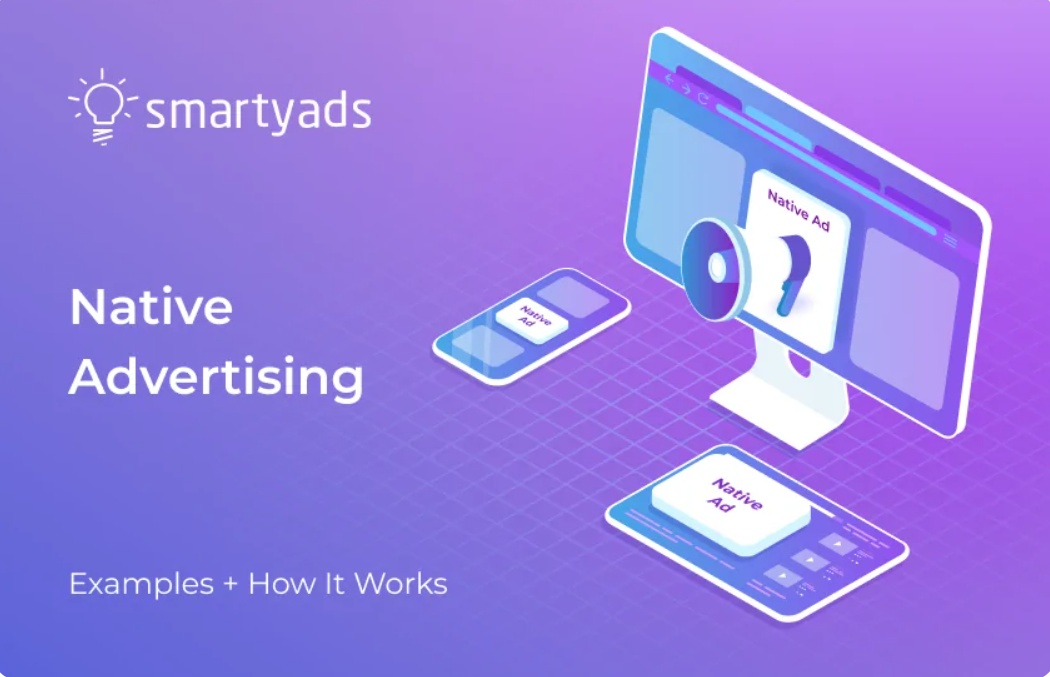
Native advertising works on one idea. Ads that look like content perform better than ads that look like ads. Native units match the font, layout, image style, and tone of the surrounding page. The placement feels editorial. The user experience stays intact. And the performance data backs this up, consistently.
The evidence is solid. A Sharethrough and IPG Media Lab study — run across 4,770 consumers with eye-tracking on 200 participants — found that people look at native ads 53% more often than standard banners. The same research showed native ads drive an 18% higher lift in purchase intent and a 9% boost in brand affinity. U.S. native display ad spending is forecast to grow 13.1% in 2026, reaching $148 billion.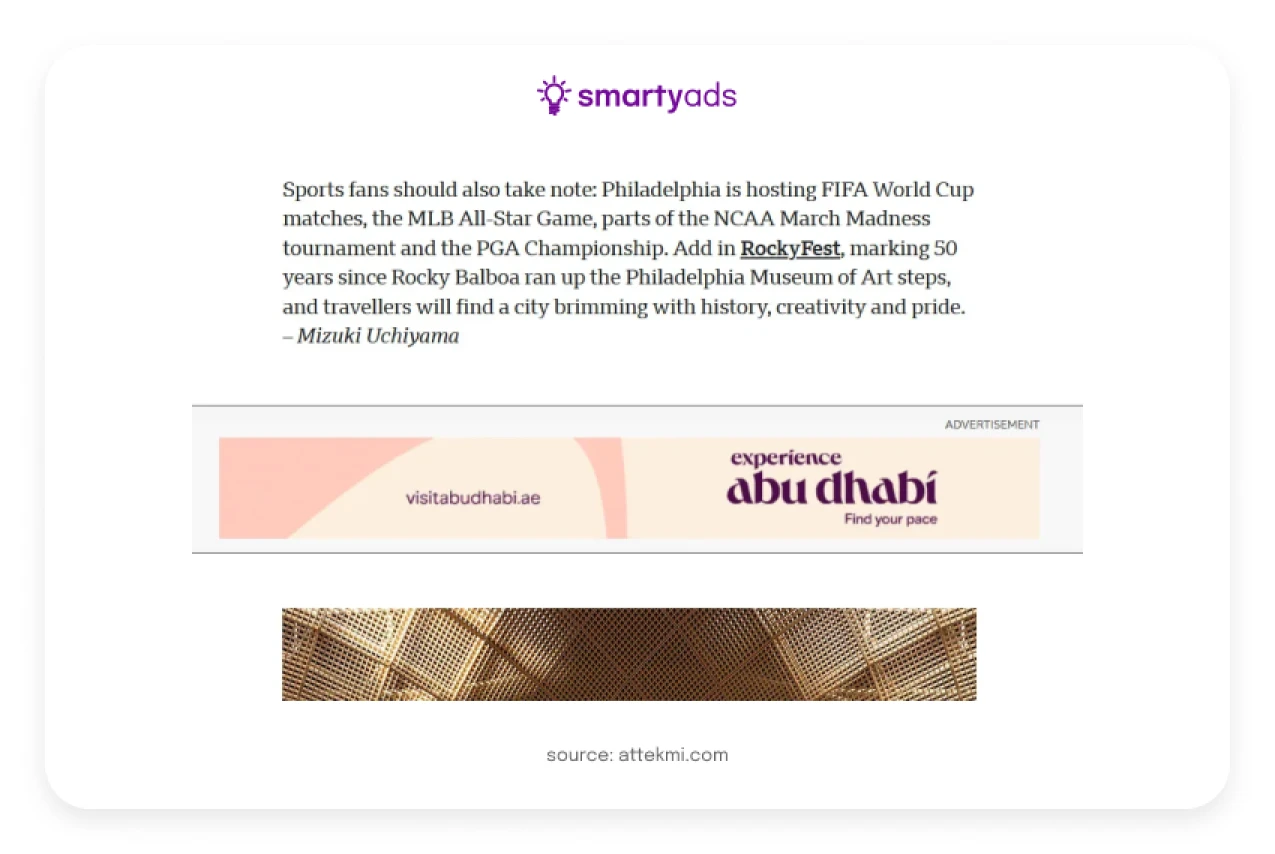
The most common native format is the in-feed unit. It sits inside an article feed or content recommendation widget. The placement is transparent — IAB rules require clear disclosure labels on all native advertising. But it cuts through the visual noise that causes banner blindness. Publishers running in-feed units also tend to see better engagement across the board. Lower bounce rates. Longer time on page. Consistent patterns on content-heavy sites.\
At the same time, native isn’t limited to static placements. Formats like immersive advertising in streams follow the same principle — integrating directly into content consumption flows such as video or social feeds, where the ad experience remains part of the content rather than interrupting it. \
Email Ads
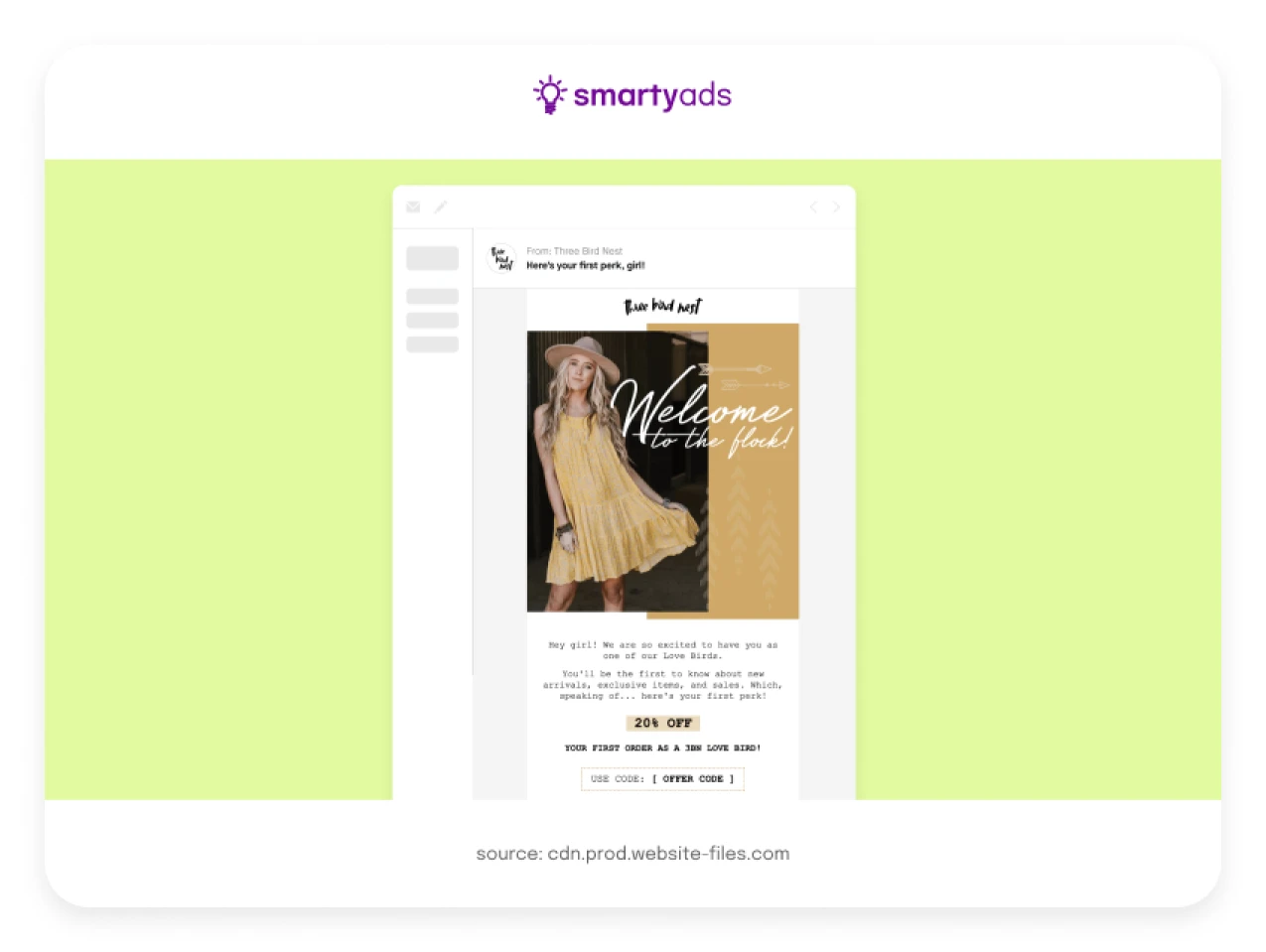
Email advertising sits at the intersection of direct communication and display. Ads are embedded in newsletters — as image units between editorial sections or as sponsored content blocks styled to match. For advertisers, the draw is audience quality. Newsletter subscribers opted in. They've shown consistent interest in a topic. That means higher-intent impressions than most programmatic channels can offer.
Email inventory is usually sold through newsletter ad networks or direct deals. CPMs vary by niche and list quality. But premium B2B newsletters routinely command $50–$100+. Well above comparable display inventory from the same audience.
For publishers with newsletters, email ads offer strong revenue per impression with minimal technical overhead. The format also has a built-in edge. Ad blockers have zero effect. Viewability is straightforward to measure. And the ad lands directly in a subscriber's inbox — not competing for attention on a cluttered webpage.
Interstitial Ads
Interstitial ads are full-screen units that appear at natural pause points. Between game levels. Between app screens. At article load. At the end of a session. They take up the entire screen. That delivers 100% viewability and eliminates competition from surrounding content.
That total-screen presence is what makes interstitials both powerful and tricky. Placed at a genuine break point — without interrupting an active task — they perform well for brand recall and conversion alike. Placed at the wrong moment, they become one of the most irritating experiences in online advertising. Google's algorithm actively penalizes mobile pages that show interstitials immediately after a user arrives from search. So timing is a real SEO issue. Far beyond a simple UX preference.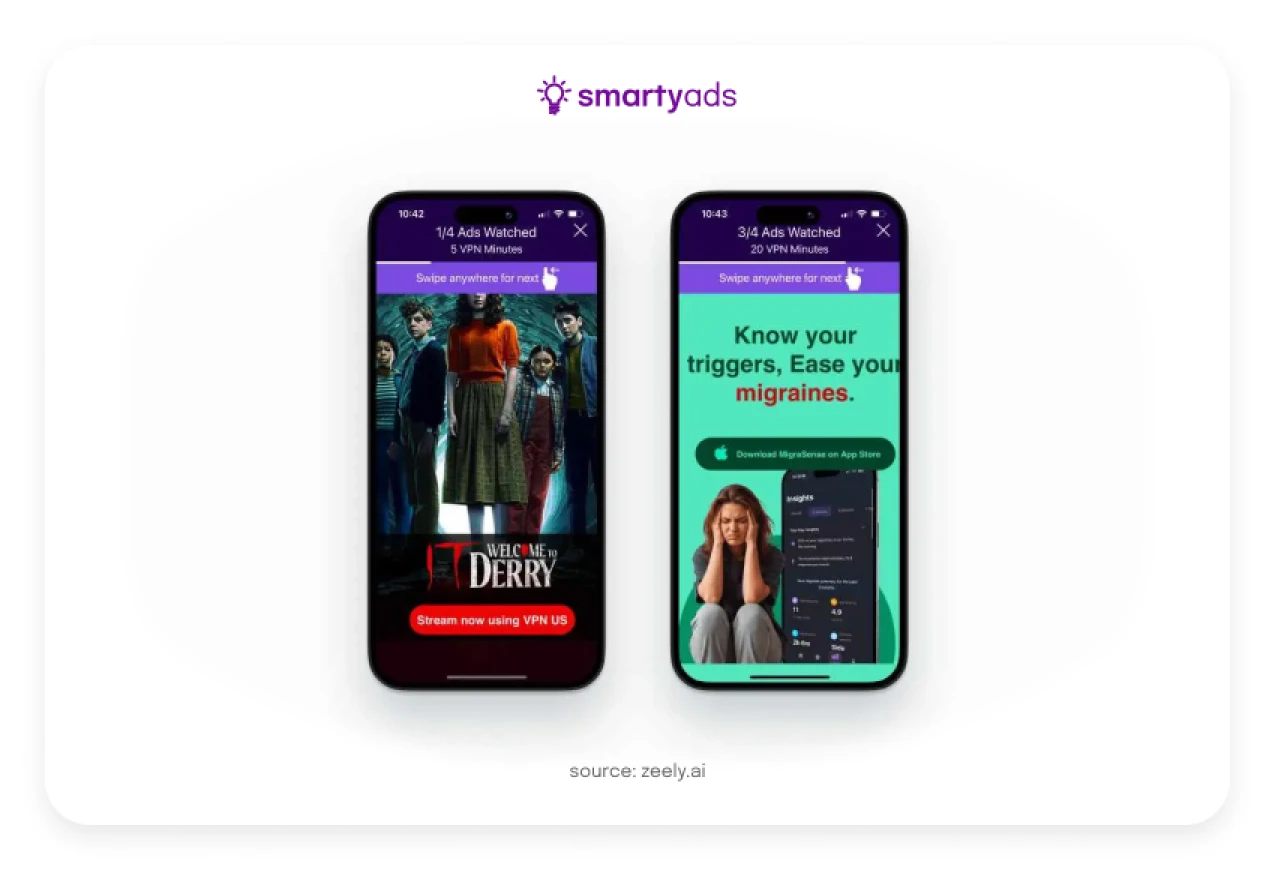
In mobile apps, interstitials are often the highest-CPM format available — for gaming and non-gaming publishers alike. Skippable versions with a visible countdown hold onto users better over time. The balance between completion rate and user satisfaction is worth watching closely in your analytics.
Rich Media Ads
Rich media ads go well beyond static images and standard video. Expandable panels. Multi-directional scrolling. Web-to-App. Embedded forms. Live data feeds. Animation. Audio triggers. Gamification. Live social content. All inside a single ad unit. The result is an experience that holds attention for seconds or even minutes — not the fraction of a second most display ads get.
The performance gap is well-documented. An Adform study cited by Publift found static banner CTR at 0.12%. Rich media hit 0.44%. That's a 267% improvement. Engagement rates tell an even bigger story — eMarketer data shows rich media HTML5 banners at 16.85% engagement versus 2.14% for static. For brand advertisers launching products or communicating multiple features, those numbers justify the higher production cost.
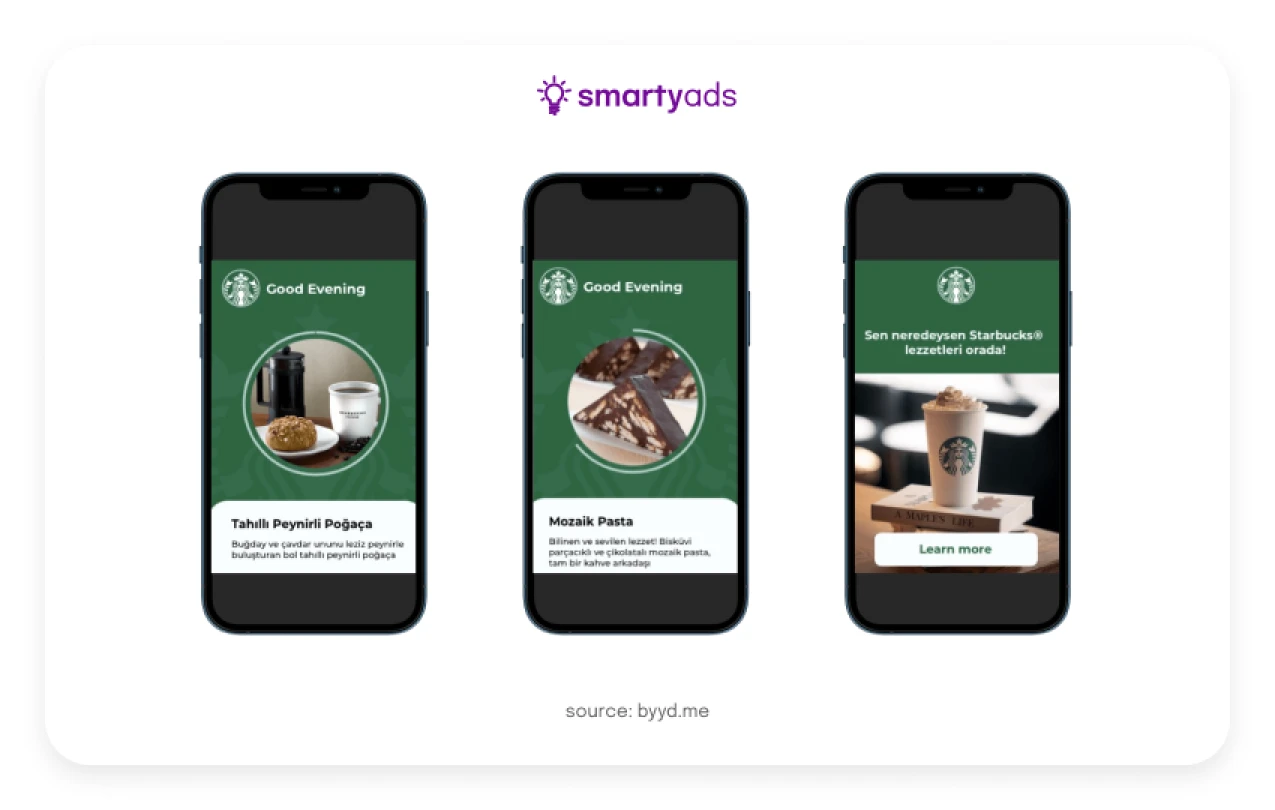
For publishers, rich media means bigger file sizes and more demanding page performance monitoring. But the CPM premium over standard display usually makes it worthwhile for publishers with strong, engaged audiences. Use it selectively. Rich media works best where users are already spending real time on the page — not as a blanket replacement for all display inventory.
How to Choose the Right Ad Formats
Format selection is a strategic call. Not a default. The same creative can produce completely different results depending on which format carries it. Across all online advertising formats, there is no universal best option. Only the format that fits a specific goal, audience, and track record.
Start with your campaign goal. Brand awareness calls for high-visibility formats. Video, interstitials, and rich media are built for impression-level impact and recall. Direct-response campaigns, where a specific action is the target, tend to work better with native, search, and retargeted display — where intent signals are already present.
Look at your audience. Mobile-first users behave differently from desktop users. Statista projects that 83.8% of digital video ad spending will come through mobile by 2030. A vertical video interstitial that works perfectly for a lifestyle app user at 9pm is completely wrong for a B2B buyer comparing software options at their desk at noon. Segmentation data should shape format selection just as much as creative preferences.
Let the data lead once campaigns are live. Track CTR, viewability rate, completion rate, and CPL or ROAS by format. The top performer in one vertical is often mediocre in another. Your own first-party data is the most reliable guide you have.
Keep testing. The landscape of digital advertising formats shifts constantly. New placements emerge. User behavior evolves. Most performance-focused teams reserve 10–15% of media budget for format experimentation. That's how you find the next high-performer before your competitors do.
Final Thoughts
Ad formats are a core part of campaign strategy for advertisers. And a primary revenue driver for publishers. Understanding the full range of digital ad formats — from basic display banners to interactive rich media — gives you a real foundation for smarter decisions at every stage of the funnel.
The opportunity is real. Global digital ad spend is heading toward $870 billion by 2027. Even small improvements from smarter format selection translate into meaningful revenue. For publishers: the variety and quality of the formats you support determines how much demand you attract and what CPMs you can command. For advertisers: let performance data drive format selection. Run an ad formats comparison across different ad formats. Measure carefully. Follow what works.
FAQ: Ad Formats for Publishers and Advertisers
An ad format is the technical and visual structure of a digital ad — its size, layout, media type, and behavior on screen. Common digital ad formats include display banners, video pre-rolls, native in-feed units, interstitials, and rich media. The format determines where and how the ad is seen. See our breakdown of examples of advertising formats across different monetization channels
It depends on your traffic and audience. Video and rich media typically deliver the highest CPMs — rich media CTRs run 267% higher than standard banners. Native performs well on content-heavy sites. For broad coverage across demand sources, a mix of display, video, and native is a solid starting point. The best ad formats for your site always come down to your own data.
The main models are CPM (per thousand impressions), CPC (per click), CPA (per acquisition), and CPV (per video view). Brand campaigns usually run on CPM. Performance campaigns favor CPC or CPA. The formats of advertising you choose will often point toward the right model naturally.
Display: CTR and viewability. Video: completion rate and view-through rate. Native: scroll depth and time on page. Interstitials: interaction rate. For any online advertising formats you run, tracking results separately by format is the only reliable way to optimize.
Run the same creative across two or three online ad formats. Keep other variables the same. Measure against your main KPI. For publishers reviewing inventory mix, check CPMs by format in your SSP dashboard. Two to four weeks of data is usually enough before scaling the winner.

.webp)