
For Titan Sunrooms, marketing has never been about trends or buzzwords. It has always been about something far more practical, more about unit economics: reaching the right homeowners, in the right places, at a cost that actually works for the business.
Titan Sunrooms manufactures and installs sunrooms, screen rooms, patio covers, pergolas, and carports. The company serves six counties across Florida and Alabama, a large territory that stretches nearly four hours from one end to the other. That geography defines everything. A lead inside the service area is valuable. A lead outside it is simply a wasted budget.
Lead generation is not a nice-to-have. It’s the core of the business.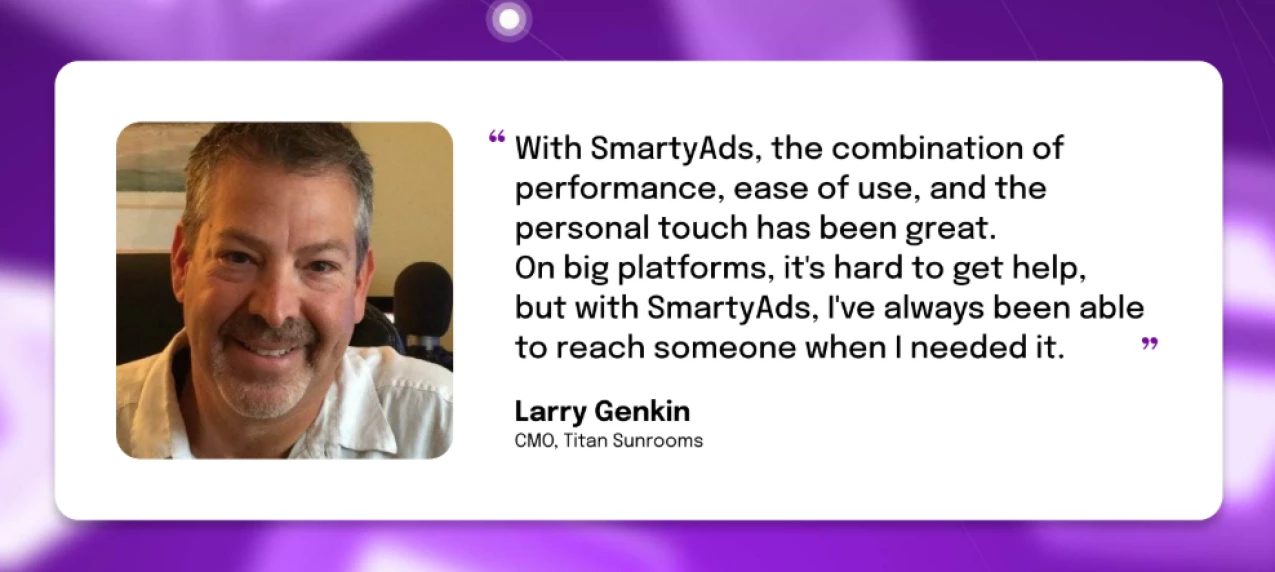
Why programmatic mattered but needed the proper setup
By the time Titan Sunrooms turned to SmartyAds, programmatic advertising was no longer new to them. They had already explored it, tested it, and tried to make it work.
On paper, the channel promised exactly what they needed: broader reach, flexible targeting, and the ability to appear beyond social platforms. In practice, it was harder to translate that promise into sustainable results. Some setups delivered traffic, but at costs that didn’t hold up once leads were measured. Others didn’t offer the financial flexibility a growing, mid-sized business needs to test carefully, adjust campaigns, and scale at its own pace.
The issue wasn’t programmatic itself. It was finding a setup where cost, control, and scale could exist at the same time. At the same time, Larry Genkin, CMO of Titan Sunrooms, knew their audience wasn’t limited to Facebook and Google.
We were already using Facebook and Google, and they worked,” he says. “But people are on many other sites too. News sites, content platforms, local publishers. We wanted visibility beyond those ecosystems.
The goal was never to replace existing channels. It was to extend reach across the open web while keeping control over costs and results.
Testing first and letting performance decide
Larry approached SmartyAds with a clear, grounded mindset. This wasn’t about jumping all in. It was about testing carefully and seeing whether the economics made sense.
From the very beginning, one thing stood out.
We were able to get very cost-effective clicks, much better than what we were seeing with other programmatic platforms.
The cost side worked almost immediately. However, early on, traffic volume was limited. Budgets couldn’t always be entirely spent, simply because the reach across the target geography wasn’t wide enough yet. For Titan Sunrooms, efficiency alone wasn’t sufficient. They needed both efficiency and scale to generate consistent lead flow.
Solving the fundamental constraint: reach and geography
About a year into the partnership, SmartyAds took a closer look at what was holding growth back. The issue wasn’t traffic quality. It was coverage.
The team expanded supply sources with a strong focus on Florida, increased available inventory, removed internal traffic limits, and updated targeting logic to modern industry standards. The goal was precise but ambitious: fully saturate Titan Sunrooms’ entire service area and strictly avoid delivery outside it.
That change marked a turning point.
Once we could actually spend through the budget and generate enough traffic and leads, everything changed,” Larry says. “That’s when we decided to put more budget into SmartyAds.
With improved reach, campaigns finally delivered on both sides of the equation. Cost-per-click remained sustainable, while volume increased enough to support meaningful lead generation. Banner display ads began running across premium open-web inventory, including well-known publishers like CNN.com, reinforcing Titan Sunrooms’ presence beyond social platforms.
A platform designed for control, not overhead
Performance may have opened the door, but usability is what turned SmartyAds into a long-term channel for Titan Sunrooms. From the beginning, Larry wanted a setup he could manage himself without layers of process or dependency on account managers for everyday actions.
Larry runs campaigns independently: adjusting budgets, monitoring performance, pulling reports, and keeping costs transparent, all through a self-serve interface.
What I really like about SmartyAds is the simplicity,” he explains. “I can do everything myself: add budget, run reports, change things when I need to. It’s clear and easy to use.
That level of independence isn’t just convenient. It has a direct impact on economics. Platforms built around heavy account management often push those costs back into CPC and CPL. By keeping operations lean and self-directed, Titan Sunrooms avoided unnecessary overhead while staying flexible and responsive.
At the same time, the platform never felt isolating. When support was needed, it was accessible and human without being intrusive.
With big platforms, it’s hard to get help. With SmartyAds, I’ve always been able to reach someone, even though the platform is so easy to use that I rarely need it.
Measuring what truly defines success
Titan Sunrooms doesn’t chase impressions for the sake of reporting. Success is measured in leads — homeowners who take action and request a quote.
Lead generation is 100% the most valuable metric for us.
Larry tracks website traffic, cost-per-click, and lead volume across all channels. Today, roughly 20% of the company’s total website traffic comes from SmartyAds. Using a proportional attribution approach, he attributes a similar share of sales to programmatic campaigns based on how traffic translates into real inquiries and consultations.
It’s a deliberately simple model, and Larry is open about its limitations. Lead quality can vary, and not every conversion follows a straight line. But the economics work, the lead flow is consistent, and results hold over time. That consistency is what ultimately justifies continued investment.
From a test to a core channel
What started as an experiment has gradually become a stable and growing part of Titan Sunrooms’ marketing mix. Over time, programmatic moved from something to validate into a channel the business could rely on.
After more than two years of partnership, SmartyAds consistently delivers cost-effective clicks, enough scale to deploy full budgets, accurate geographic targeting, and a measurable contribution to sales without adding operational complexity.
According to Dmytro Sekiro, Head of DSP at SmartyAds, the case reflects a disciplined, business-first approach to programmatic growth:
Titan Sunrooms focused on geography, cost efficiency, and lead generation. When those are aligned, scaling becomes a logical step, not a risk.
The takeaway
Programmatic didn’t become a growth driver for Titan Sunrooms because of hype or experimentation for its own sake. It worked because the setup finally matched the business reality.
Accurate geography, controlled costs, and clear measurement made a deal for the business. That combination turned programmatic display into roughly 20% of sales and into a channel the company continues to grow with confidence.