There's this scene in a Spielberg film where Tom Cruise walks through a shopping mall and holographic billboards scan his retinas, calling out to him by name – "John Anderton! You could use a Guinness right about now." The scene now looks both impressive and unsettling, this vision of a future where advertising knows exactly who you are and what you want before you do. The film is Minority Report, released in 2002, and it imagined advertising infrastructure that was extremely intelligent and deeply integrated into daily life.
We're obviously not there yet with the retina-scanning billboards. But something potentially just as significant is happening in the less visible infrastructure that powers digital advertising today.
What AdCP Actually Is (And Who's Behind It)
In October 2025, a coalition of more than 20 advertising companies launched the Ad Context Protocol (AdCP), an open standard designed to standardize how AI agents communicate with one another in advertising. The founding members include Yahoo, PubMatic, Optable, Scope3, Swivel, and Triton Digital, with additional supporters like Magnite, Kargo, and The Weather Company joining at launch.
AdCP is built on top of Anthropic's Model Context Protocol. If you're into the technical weeds, you can check out the full specification on GitHub. The protocol has since expanded beyond its initial media-buying and audience-activation focus. Current documentation covers capabilities across media buying, creative, signals, accounts, governance, brand, and other advertising workflows. Support for individual capabilities depends on the implementation, and curation remains listed as forthcoming in the current documentation.
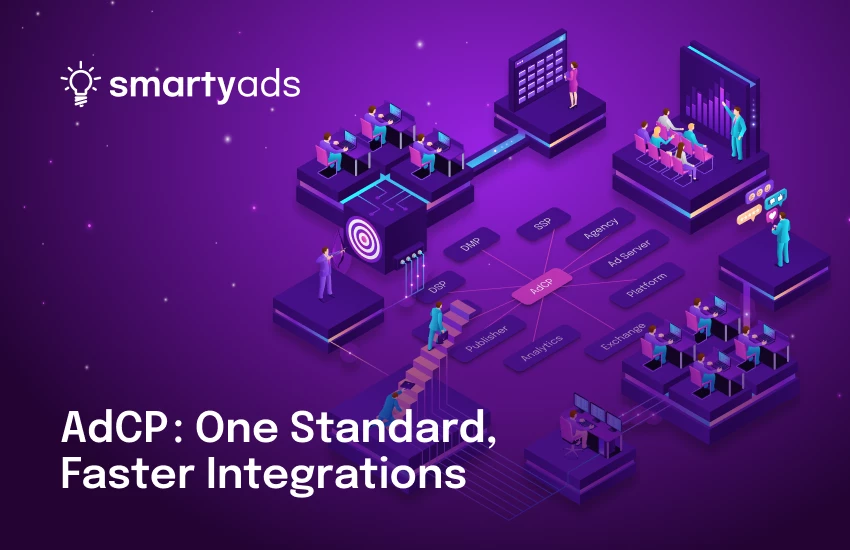
AdCP is a protocol – a set of rules that allow different software systems to talk to each other. Built on Anthropic's Model Context Protocol, it provides a common interface for AI agents to exchange context and manage ad buying across platforms.
The whole point here is cutting through the complexity that exists today. DSPs, SSPs, agencies, and tools can potentially integrate without spending months on custom development. New systems, especially AI agents, can work with compatible platforms through standardized interfaces rather than requiring a separate integration for every connection. And advertising data can become more structured and standardized.
That doesn't mean every platform can connect to every other platform automatically. Both sides need compatible implementations, and the available workflows depend on which protocol capabilities each agent supports..webp)
The Technical Foundation
Today's advertising industry operates through dozens of different APIs, formats, and non-standard integrations. This fragmentation creates operational challenges. Each partner may have its own requirements, endpoints, and ways of transferring data. Implementing new tools can take weeks or months.
AdCP addresses this by enabling advertising platforms to speak a common language – a shared standard for supported advertising operations rather than dozens of unrelated integrations. The protocol provides structured ways to exchange information about media buying and other advertising tasks, while enabling compatible AI agents to interact with advertising systems.
AdCP builds on existing communication technologies, including Model Context Protocol (MCP) and Agent-to-Agent (A2A) transports. MCP and A2A define how agents communicate; AdCP defines the advertising-specific tasks and information exchanged through those connections. It can operate alongside existing platform APIs rather than replacing every proprietary interface.
What makes this different from previous attempts at standardization? The people involved, for one thing. The founding members are from different parts of programmatic advertising: supply-side platforms, sustainability measurement, audience analytics, audio advertising, and data collaboration tools.
In other words, this is an attempt to create shared infrastructure before everyone builds incompatible solutions.
According to PubMatic's Kyle Dozeman, campaign planning, audience analytics, media activation, and troubleshooting are all components where agents are being tested, with the expectation that agents may eventually connect more parts of a campaign workflow.
Understanding Buyer's Agents and Seller's Agents
The agentic model introduces two key participants that can support advertising transactions:
- Buyer's agents work for advertisers. Depending on their implementation, they can help discover inventory, prepare media buys, manage campaigns, and track performance.
- Seller's agents represent publishers and media companies. They can expose information about inventory availability, pricing, sales rules, advertising products, and buyer access.
- Both types of agents can communicate through AdCP-compatible interfaces. The protocol also includes standardized mechanisms for discovering agents and understanding which capabilities they support.
A buyer agent's ability to perform a particular operation depends on the seller agent exposing the corresponding capability and on the required authentication and permissions being in place.
This creates opportunities to coordinate tasks that would otherwise require separate manual steps or custom integrations. However, the protocol defines how compatible systems can interact; it does not mean every buyer and seller has already automated these workflows.
.webp)
How AdCP Could Change Everything
Agent-to-agent transactions have become the standard way of doing things. Instead of publishers running real-time auctions where buyers bid against each other, advertiser agents would just communicate directly with publisher agents about what they need. Instead of relying exclusively on manual processes or separate platform integrations, compatible buyer and seller agents can exchange information about advertising needs and available inventory through standardized workflows.
Here's how a potential transaction might work:
- A marketer makes a request to the buyer's agent: "I want to buy weather-relevant inventory from The Weather Company. Budget: $20,000, or 200 million impressions."
- The buyer's agent converts this into structured requirements, including budget, audience, formats, and other campaign constraints.
- The buyer's agent contacts a compatible seller agent through AdCP to ask about available inventory, pricing, audience segments, and potential packages.
- The seller's agent responds with relevant inventory information, available options, pricing, restrictions, and access rules.
The buyer's agent can evaluate the response and, where supported, continue with further requests or prepare a proposed media buy. Negotiation, transaction execution, and approval requirements depend on the implementation and the capabilities available on both sides. They should not be assumed to happen automatically in every AdCP workflow.
Premium supply could get better representation. This has been a chronic problem in programmatic advertising: high-quality publishers can struggle to differentiate themselves in environments where everything is reduced to CPMs. When agents can query structured information about content contexts, audiences, and advertising products, premium inventory may become easier to discover and evaluate.
Barriers could also drop for smaller buyers. Right now, effective programmatic buying often requires technical expertise and agency partnerships. If natural-language interfaces and compatible agentic protocols become practical for more advertisers, smaller buyers could gain access to workflows that have traditionally required more resources. How much easier this makes buying – and for whom – will depend on the available tools, integrations, and commercial arrangements.
AdCP, AAMP and OpenProposal: How the Standards Differ
AdCP is not the only initiative working on agentic advertising, and the related standards are not different versions of the same protocol. They address overlapping but distinct parts of the ecosystem.
AdCP (Ad Context Protocol) is an open protocol for connecting advertising agents and platform workflows. It defines advertising-specific tasks and information that compatible agents can exchange.
AAMP (Agentic Advertising Management Protocols) is IAB Tech Lab's broader initiative for bringing agentic AI into advertising through shared standards, agent frameworks, and supporting infrastructure.
OpenProposal is a specification introduced with AAMP 3.0. It provides a structured, agent-readable format for sellers to describe advertising products and respond to buyers' media briefs.
Two developments in 2026 illustrate how this wider ecosystem is evolving.
In July 2026, IAB Tech Lab released AAMP 2.3, focusing on enterprise deployment, interoperability, privacy diligence, and pricing integrity. The release aims to make agentic advertising workflows more practical to operate within existing advertising infrastructure.
In September 2026, IAB Tech Lab announced AAMP 3.0 with OpenProposal. OpenProposal addresses the stage between a buyer's brief and a potential buying commitment: it gives sellers a standardized way to describe advertising products and enables buyer agents to discover and compare proposals against campaign requirements. As of October 19, 2026, the specification remains open for public comment through October 22, 2026.
These initiatives are related in their broader goal of enabling agentic advertising, but they are not interchangeable. AdCP defines advertising workflows and agent interactions; AAMP is IAB Tech Lab's framework initiative; OpenProposal is a particular specification within AAMP 3.0. Support for one does not establish support for the others.
Where SmartyAds Fits Into This Picture
As an independent DSP, we've always taken what I'd call a practical approach to industry standards. We adopt innovations when they actually deliver proven value to media buyers.
With AdCP specifically, our approach right now is informed observation. The protocol is technically sound. The coalition behind it is credible — these aren't random startups, they're established players. And the problems it's trying to address? Fragmented workflows, rising operational costs, inefficient discovery of inventory and audiences — these are all very real, very painful problems.
Our commitment is to interoperability. As standards like AdCP mature and actually prove themselves through real implementation and measurable improvements in campaign performance, we can and will integrate them in ways that’ll enhance audience discovery, operational efficiency, and transparency for our buyers.
That might mean supporting AdCP-based audience activation at some point. Or integrating with agentic buying tools if they prove valuable. Or connecting to new inventory sources that the protocol makes available.
Our goal is to stay flexible and adaptable. Because let's be honest — most innovations in adtech don't pan out. Media buyers need partners who can tell the difference between something that works in practice.
What Comes Next
AdCP represents what I'd call a considered bet on where advertising infrastructure is headed. Whether it becomes foundational depends on adoption, implementation quality, and how well the protocol addresses real operational needs.
What is certain is that the underlying problems aren't going away: fragmented workflows, complex integrations, and the effort required to discover, plan, and manage media buys remain real challenges.
So the question isn't whether the industry needs better solutions. It does. The question is how effectively AdCP and other initiatives can address these problems, and whether the industry can coordinate around shared standards for agentic advertising.
For now, AdCP is worth watching closely. The coalition is substantial, the technical approach aims to address genuine integration challenges, and the protocol continues to evolve. As the ecosystem develops, implementations and measurable results will provide a clearer picture of its practical value.
The media-buying landscape has weathered plenty of supposed revolutions that ended up being incremental evolutions. Maybe AdCP will become a foundational part of advertising infrastructure. Or perhaps it will remain one of several protocols serving different use cases. It's too early to say.
Either way, the conversation about making media buying less manually intensive and more intelligently automated isn't going away anytime soon. AdCP is one possible answer to that challenge. Time will tell how widely it is adopted and where it delivers the most value.
In Minority Report, the future of advertising just worked perfectly. The mall had it, the transit system had it, everything was connected and functional and seamless. But that's because Spielberg's film conveniently skipped over all the boring parts – the years of building protocols, testing agents, arguing over standards, and watching implementations struggle when systems couldn't agree on how to communicate.
We're living through those boring parts right now. AdCP is one piece of that larger puzzle.
Maybe it becomes the foundation everyone eventually builds on. Maybe it becomes one of several standards in a diverse ecosystem. What matters now is how well the protocol's capabilities are implemented, how reliably agents can work together, and whether those workflows create measurable value for advertisers and publishers.