

A shooter game and a match-three puzzle app don't look for players the same way — and neither should the platform buying their ad inventory. Gaming has its own formats, its own audience logic, and its own fraud problems, and a DSP built for standard display or CTV campaigns often handles all three poorly. This guide compares the demand-side platforms agencies and studios actually use to reach players in 2026, from rewarded video specialists to full-stack platforms like SmartyAds DSP that treat gaming as one channel among several rather than the whole business.
Key takeaways:
- In-game advertising is projected to grow from $11 billion in 2025 to $12.5 billion in 2026, and mobile alone drives over $62 billion in global ad revenue.
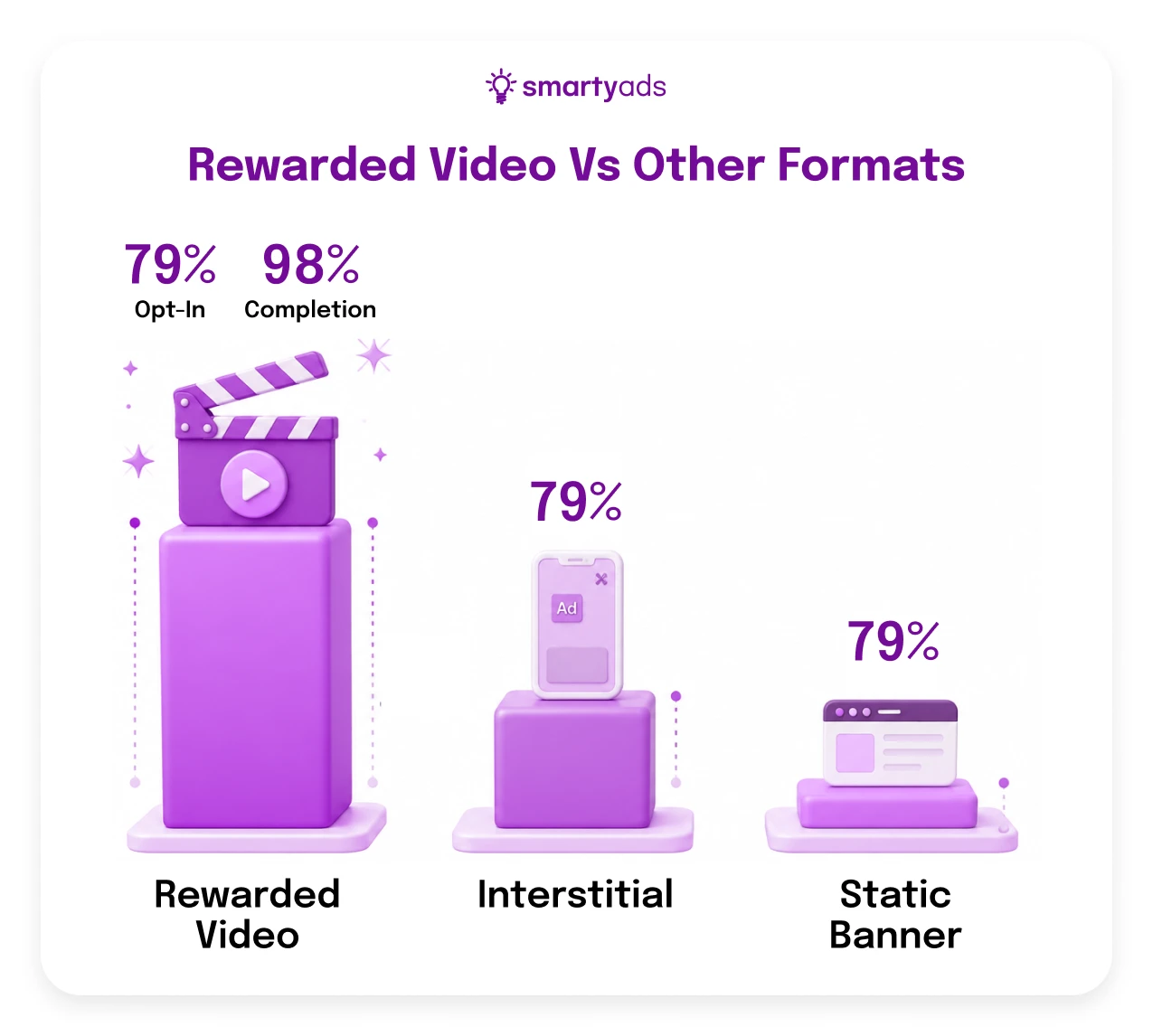
- Rewarded video consistently outperforms other formats — engagement rates around 92% and opt-in rates near 79%, well above interstitials or static banners.
- Programmatic already reaches 73% of the top 200 mobile games, which means manual ad-network deals are no longer the default.
- Not every "gaming DSP" is actually a DSP — some, like AppLovin Ads, are closed ad networks running on their own inventory and bidding logic.
- Fraud prevention and viewability matter more in gaming than almost any other vertical, given how much rewarded and playable inventory runs through app mediation stacks.
- The right platform depends on whether you're a game studio doing user acquisition or a brand advertiser trying to reach gamers as an audience — those are different jobs.
Why Gaming Is Becoming a Major Advertising Channel
Gamers aren't a niche audience anymore — they're most of the internet. Mobile gaming alone is on track to top $107 billion in 2026, more than half of all global gaming revenue, and the average player in the US spends over an hour a day inside a game. Ad spend hasn't fully caught up to that attention yet: in-game advertising is projected at roughly 2.3% of total digital ad spend in 2026, even though users routinely spend more time in games than in most other apps combined.
That gap is exactly why gaming keeps pulling in new advertiser categories every year. What used to be a channel almost exclusively for other mobile games — one app buying installs for another — now includes CPG, fintech, entertainment, and retail brands running standard awareness and performance campaigns against gaming audiences. Programmatic is doing most of the heavy lifting behind that shift: it already reaches 73% of the top 200 games, replacing the direct ad-network deals that used to dominate mobile monetization. Rewarded formats are a big part of why. Players opt into rewarded video at rates near 79%, and completion rates in top networks hit 98% — numbers that make traditional interruption-based formats look almost primitive by comparison.
For a DSP to compete for that inventory, it needs real-time bidding infrastructure that understands gaming's specific mechanics — not just a display or CTV stack with a "mobile" checkbox added on.
Key Features for Gaming Campaigns
Not every feature that matters for a display or CTV buy matters the same way for gaming. Here's what actually moves results in this vertical:
- Rewarded video support. This is the highest-performing format in mobile gaming, and a DSP without native rewarded inventory access is starting from behind. Rewarded ads deliver roughly 3x the eCPM of interstitials, landing in the $15–$25 CPM range in most networks.
- In-game inventory. Interstitials and banners are easy to buy through app exchanges, but actual in-game placements — billboards, sponsored items, and ads built into the game itself — usually require direct publisher or SDK integrations.
- Audience targeting. Gamers aren't a single audience. Someone grinding on console, someone playing casually on mobile, someone deep into a PC title — they spend differently, play for different stretches of time, and stick to different platforms. Age and location won't tell you much about any of that, so targeting works better when it's built on gaming-specific data instead.
- Fraud protection. Mobile inventory — rewarded and playable ads sold through mediation platforms in particular — is an easy target for click spam, SDK spoofing, and fake installs. Ask whether the platform screens traffic before the bid happens and partners with traffic-quality vendors, instead of just catching problems in a report after the campaign's already run.
CTV and mobile coverage. Gaming isn't limited to phones anymore. Audiences are also spending time on CTV and connected consoles, so a platform focused only on mobile inventory can leave part of that audience out.
Comparison Table
Platform Gaming Focus Mobile Rewarded Video CTV AI Optimization SmartyAds DSP Full-stack DSP with dedicated gaming formats Yes Yes Yes AI adaptive bidding StackAdapt Multichannel DSP with gaming-adjacent reach Yes Limited Yes Predictive bidding, bid shading AppLovin Ads Closed ad network built for gaming UA Yes Yes No Axon AI engine Moloco ML-driven in-app DSP Yes Yes No Deep-learning bid prediction DV360 Enterprise DSP, gaming as one vertical among many Yes No Yes AI campaign planning The Trade Desk Open-web DSP, limited native in-game inventory Yes No Yes Kokai AI bidding
SmartyAds DSP is the only platform here that pairs a genuine self-serve entry point with rewarded video, CTV, and mobile coverage in one account — most gaming specialists trade away CTV, and most CTV-strong DSPs don't carry gaming-native rewarded inventory at all.
Not sure which format mix fits your campaign? See how SmartyAds DSP handles gaming inventory →
Best Gaming DSPs
SmartyAds
Overview: SmartyAds DSP runs gaming campaigns across the full spread of mobile formats — banner, playable, rewarded, interstitial, and native — alongside CTV, DOOH, and standard display, all from one self-serve account with a $1,000 minimum deposit. AI-driven adaptive bidding adjusts bid floors against live auction data, and advertisers can filter or whitelist specific apps to control exactly where gaming inventory runs. Because the DSP isn't gaming-exclusive, brands running gaming audiences as part of a broader media mix don't need a second platform for their CTV or web-to-app buys.
Expert tip from SmartyAds: Cap interstitials at two or fewer per session and retention jumps 27%. Rewarded ads still win on opt-in rates over any other mobile format. If you're leaning on rewarded and native instead of firing off interstitials constantly, you'll usually get better engagement — without giving players a reason to just delete the app.
Best for: Agencies and brands that need gaming-native formats alongside other channels — CTV, DOOH, web-to-app — in a single self-serve platform.
Pros:
- Covers rewarded, playable, and native gaming formats without requiring a separate gaming-only vendor
- CTV and DOOH support lets you reach gaming audiences beyond just in-app placements
- A $1,000 entry deposit keeps testing cheap compared to gaming-specialist platforms, which often demand a lot more upfront
- App-level whitelisting and blacklisting lets you decide exactly where your ads show up
Cons:
- Doesn't carry the scale of AppLovin's or Moloco's mobile-gaming-exclusive inventory networks
- Machine-learning bid prediction is less specialized for gaming LTV modeling than platforms built solely around it
StackAdapt
Overview: StackAdapt isn't built for gaming specifically, but it does have in-game and native inventory, plus solid CTV and display reach — enough to fold gaming audiences into a broader multichannel buy without treating them as the whole strategy. Predictive bidding and bid shading run in the background, and the interface doesn't require gaming UA expertise to pick up.
Best for: Agencies where gaming is a slice of a bigger multichannel campaign, not the main event.
Pros:
- Quick to learn, no gaming background needed
- CTV coverage is solid, so gaming-adjacent reach isn't limited to mobile
- No stated spend minimum, so you can test without much risk
Cons:
- Rewarded video and playable ads are thinner here than on platforms built specifically for gaming
- Doesn't have gaming-specific audience or LTV modeling baked in
AppLovin Ads
Overview: AppLovin Ads (formerly Axon) is less a traditional DSP and more a closed, AI-run ad network — it reaches over a billion daily active users through its own network of 140,000+ mobile apps, most of them games, and its Axon engine handles targeting, creative optimization, and bidding without much manual control from the advertiser. Self-serve access opened to all advertisers in 2026, a shift from its earlier referral-only model, and it now supports ROAS and cost-per-purchaser bidding for both gaming and, increasingly, e-commerce advertisers.
Best for: Mobile game studios running user acquisition at scale, where AppLovin's own app network is the primary target audience.
Pros:
- Massive first-party reach across its own mobile gaming app network
- Axon's AI bidding has a strong track record specifically for game install and in-app purchase optimization
- Self-serve access with no revenue gate as of 2026
Cons:
- Inventory is largely confined to AppLovin's own network — not an open-exchangeDSP with broad publisher access
- No CTV support, and not much use beyond pure mobile UA
- Less visibility into supply paths compared to open-auction DSPs
Moloco
Overview: Moloco is a machine-learning DSP built for app advertisers, with a particular edge in mobile gaming, fintech, and e-commerce. Instead of bidding on clicks or installs, its models bid on predicted lifetime value, refreshed every hour, running through roughly 600 billion bid requests a day across about 2.7 million apps. You'll typically need an agency partner to get account access, and realistic starting budgets sit around $1,000–$5,000 depending on region — though the ML model needs real budget and clean event data behind it before it starts beating simpler bidding approaches.
Best for: Game studios and app marketers running LTV-based bidding, provided they already have clean, server-side conversion data to feed it.
Pros:
- Deep-learning bid prediction built around in-app purchases and LTV, not generic goals
- Fraud filtering and traffic-quality checks come built into the platform
- Access to exclusive in-app inventory, including AppLovin and IronSource supply
Cons:
- Needs real spend and clean data to train properly — at low budgets, simpler bidding often wins out
- No native CTV support, and self-registration is limited in most regions
- Not much use for brand advertisers without app-install or in-app event goals
DV360
Overview: For Google's DV360, gaming is just one vertical inside a much bigger inventory footprint that spans display, video, YouTube, CTV, and audio across 90+ exchanges. There's no gaming-native format here — no rewarded video, no playables — but the scale and cross-device identity resolution make it a fair option for brand advertisers who want gaming audiences as a targeting segment within a wider campaign, rather than running dedicated in-game placements.
Best for: Enterprise brand advertisers targeting gaming audiences as one segment within a larger, cross-channel media plan.
Pros:
- Cross-device identity resolution helps you track gaming audiences across mobile, desktop, and CTV
- Massive overall inventory scale through Google's exchange access
- Strong first-party audience data for demographic and interest-based gaming segments
Cons:
- No rewarded video, playable, or other gaming-native ad formats
- Requires a Google Marketing Platform contract — no genuine self-serve tier, and a ~$50,000/month practical minimum
- Not built for UA-style, install-driven gaming campaigns
The Trade Desk
Overview: The Trade Desk's open-web inventory and Kokai AI bidding engine give it broad reach across CTV, video, audio, and display, but it doesn't carry the gaming-native rewarded or playable inventory that mobile-first platforms specialize in. It works best for brand advertisers who want to reach gaming audiences through CTV and streaming placements — a growing overlap as more games stream on Twitch and gaming content moves onto connected TV — rather than for install-driven mobile UA.
Best for: Brand advertisers reaching gaming audiences through CTV, streaming, and open-web video, rather than in-app formats.
Pros:
- Solid CTV and streaming inventory, useful for reaching gaming-adjacent audiences watching esports or gaming content
- UID2 identity framework offers more flexibility than walled-garden alternatives
- Transparent, itemized fee structure once inside the platform
Cons:
- No dedicated gaming ad formats — rewarded video and playables aren't part of its inventory
- High minimum spend, typically $25,000–$50,000+ per month through agency access
- Not designed for mobile game user acquisition
How to Select a Gaming DSP
The right platform depends heavily on what "gaming advertising" actually means for your campaign — those are two different jobs wearing the same label.
- Are you acquiring users for a game, or reaching gamers as an audience? Game studios doing UA need rewarded video, playable ads, and install-optimized bidding — that points toward AppLovin, Moloco, or SmartyAds. Brands targeting gamers as a demographic for a non-gaming product are better served by DV360 or The Trade Desk, where gaming is a targeting segment, not the whole inventory type.
- How much control do you need over where ads run? Closed networks like AppLovin handle most of the optimization themselves, but you don't get much visibility into exact placements. Open DSPs like SmartyAds let you decide yourself which apps go on a whitelist and which get blocked.
- Do you need CTV alongside mobile? Gamers aren't just on their phones — they're watching streams, esports, playing on connected consoles. Platforms without CTV, like AppLovin and Moloco, simply won't reach that part of the audience.
- What's your realistic budget, and how much conversion data can you actually feed the model? ML platforms like Moloco need real spend and clean event data to train properly. Cut corners on either, and the model ends up doing worse than a plain rules-based bid.
- How much does fraud prevention matter for your format mix? Rewarded and playable inventory running through mediation stacks carries more risk than standard display. Check for pre-bid filtering and traffic-quality partnerships before putting real money behind it.
Would the campaign actually do better split across two platforms? Studios often run AppLovin or Moloco for pure UA, then bring in a broader DSP like SmartyAds for CTV, DOOH, and non-install brand campaigns aimed at that same audience.
FAQ
A DSP buys inventory programmatically, in real time, across a wide range of exchanges and publishers — advertisers get visibility and control over where their ads actually run. A closed ad network like AppLovin Ads mostly runs on its own inventory instead. You lose transparency into individual placements, but performance within that network is often stronger.
Generally, yes. Rewarded video has the best opt-in and completion rates of any mobile ad format, and eCPMs run roughly 3x higher than interstitials. It's also the one format players actually choose to watch instead of just putting up with.
Some can. SmartyAds DSP and DV360 both cover mobile and CTV from one account, while gaming specialists like AppLovin and Moloco stick to mobile only. If your campaign needs both, that cuts the realistic shortlist down fast.
Depends on the platform. SmartyAds DSP starts with a $1,000 deposit, Moloco's ML model generally needs $1,000–$5,000 a month to perform reliably, and enterprise platforms like DV360 or The Trade Desk really need $25,000–$50,000+ a month before they start paying off.
Rewarded and playable formats routed through app mediation stacks are a known target for click spam and SDK spoofing, so yes — platforms with dedicated traffic-quality partnerships and pre-bid filtering are worth prioritizing over ones that only report fraud after the fact.
Getting Started with Gaming Campaigns
Testing gaming inventory doesn't have to mean committing to a gaming-only vendor before you know whether the audience converts for your product. On SmartyAds DSP:
- Create a self-serve account and fund your first campaign with a $1,000 deposit
- Select gaming-specific formats — rewarded video, playable, native, or interstitial — alongside any CTV or display inventory you're already running
- Use app-level whitelisting to control exactly which titles and genres your ads show up in
- Launch and track performance in real time — adjust bids and creative yourself, no need to wait on a managed trading desk
Conclusion
Gaming works best for advertisers who don't try to squeeze it into a generic display or CTV playbook — the formats are different, the audience behaves differently, and the fraud risks aren't the same either. The DSPs that actually perform well here tend to fall into two camps: mobile UA specialists like AppLovin and Moloco, or self-serve platforms that build gaming formats right in instead of pushing advertisers toward a separate vendor. SmartyAds DSP falls into the second camp — rewarded video, playables, and native gaming formats live in the same account as CTV, DOOH, and standard display, and you can start testing for $1,000 instead of committing six figures upfront. Whether the goal is acquiring players for a new title or just reaching gamers as an audience for something else, campaigns can go live fast.
Request a SmartyAds DSP Demo → Talk to our team today
.webp)