

.webp)
In 2024, 48% of digital political ad budgets went out in the final 30 days, with nearly half of that spending concentrated in the final 10 days. In 2026, political ad spending is projected to reach $11.6 billion, making those final weeks even more competitive.
GOTV audiences are tighter, premium inventory is under pressure, voters can get overexposed, and there may be only a few days to act on a performance signal.
This article looks at GOTV targeting from that practical perspective: what to watch, where campaigns typically lose efficiency, how CTV, display, and audio fit into the final push, and how SmartyAds DSP can give buyers more visibility and control when there’s no time for slow optimization.
Key takeaways:
- The closer Election Day gets, the less room there is for broad targeting, excessive frequency, or slow decision-making.
- GOTV buyers need to know which voter segments deserve more budget (and which impressions are being wasted).
- The challenge of coordinating CTV, display, video, audio, and native without creating multiple disconnected buying workflows.
- Waiting until the final days to secure inventory means higher competition, limited availability, and fewer options for scaling.
- Depending on a single platform can leave campaigns exposed to inventory limitations or policy changes during the most important part of the cycle.
- Creative needs to evolve with the audience: voting information, deadlines, reminders, and proven messages become more important as Election Day approaches.
- During GOTV, media infrastructure needs to be ready before the final two weeks begin; there is very little time to fix operational problems once the window opens.
GOTV Is a Different Targeting Problem
Earlier in the cycle, campaigns are trying to answer a broad question: Who can we persuade?
GOTV asks something more specific: Who do we need to reach now to get them to act?
That can include supporters who need a reminder, voters who have not yet made a plan to vote, early voters who need deadline information, or narrow groups of persuadable voters in a competitive district.
The targeting strategy therefore becomes more granular.
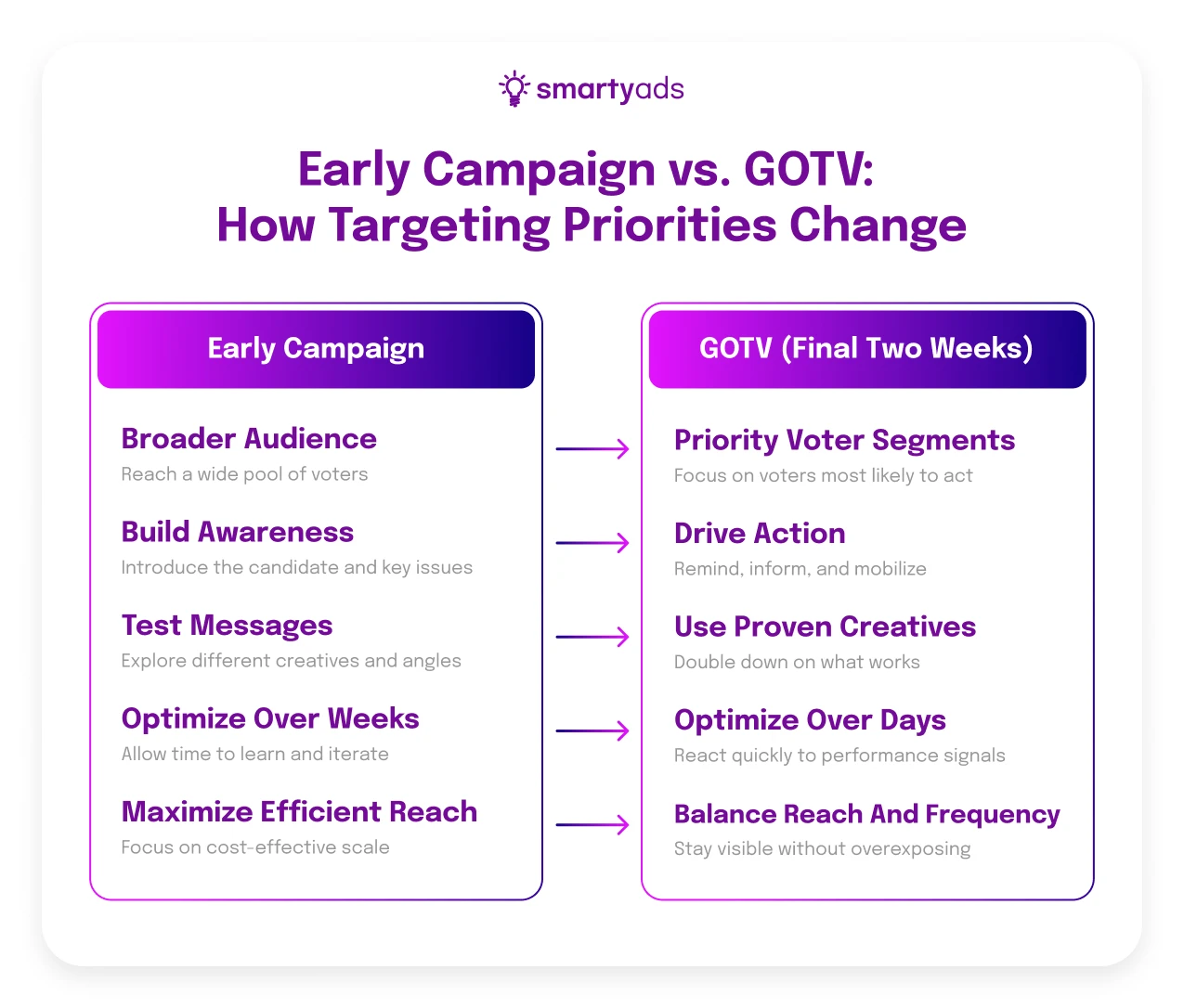
This is where programmatic buying can become particularly useful. Instead of treating the electorate as one audience, campaigns can combine geographic targeting, audience data, contextual signals, and frequency controls to concentrate spend where it matters most.
SmartyAds DSP supports audience targeting and programmatic buying across multiple digital environments, giving political advertisers more flexibility than a campaign built around a single media platform.
If your GOTV strategy still relies on broad reach alone, this is the point in the cycle to start thinking about audience precision and frequency.
CTV, Display, and Audio Each Play a Different Role
CTV is likely to be one of the most important pieces of the final-stage media mix because it combines video storytelling with the targeting capabilities of digital advertising.
But CTV does not need to carry the entire GOTV strategy.
Display and online video can reinforce a message throughout the day. Audio can reach voters while they commute, work out, or listen to podcasts. Native placements can put campaign messages into the content environments voters already use.
The advantage of combining formats is the ability to build cross-channel frequency without forcing the campaign to buy the same audience through the same platform.
| Channel | GOTV role | Best use |
| 1. CTV | High-impact reach | Candidate/message reinforcement |
| 2. Online video | Incremental video reach | Frequency and audience extension |
| 3. Display | Efficient reminders | Retargeting and repeated exposure |
| 4. Audio | Screen-free reach | Commuting, podcasts, daily routines |
| 5. Native | Content-led messaging | Additional contextual exposure |
For campaigns trying to reach specific voter groups in specific districts, this flexibility matters.
SmartyAds offers programmatic media buying across formats including CTV, video, audio, display, and native, allowing advertisers to build a coordinated media plan rather than treating each channel as a separate campaign.
Looking to extend GOTV beyond CTV? Explore SmartyAds' programmatic media buying capabilities to build a cross-channel campaign around the audiences and inventory that matter most.
The Inventory Problem Gets Bigger as Election Day Gets Closer
Every campaign knows the final weeks matter. So every campaign is trying to buy them.
That puts pressure on premium inventory, particularly in competitive geographic markets. A campaign that waits until the final days to decide where its GOTV budget will go risks finding that the inventory it wanted is either more expensive, less available, or already heavily competed for.
This is one reason inventory strategy needs to be built before the final two weeks, not during them. It is also why relying entirely on one platform can create unnecessary risk.
Meta has confirmed that it will block new political, electoral, and social-issue ads during the final week of the 2026 U.S. election campaign. Ads that have already received at least one impression before the restriction period can continue running.
That policy means campaigns need a media plan that does not depend on a single source of supply.
A diversified programmatic strategy can keep CTV, display, video, audio, and other channels working alongside walled gardens – rather than leaving the campaign exposed when one platform changes what it allows.
The Message Has to Change, Too
GOTV creative is not simply the earlier campaign message with a voting date added.
The closer the election gets, the more immediate the communication becomes.
Instead of spending valuable impressions explaining who the candidate is, campaigns can use the final stretch to reinforce the decision voters are already making and remove friction from the act of voting.
That can mean:
- Reminding voters when and where they can vote
- Promoting early-voting dates
- Highlighting mail-ballot deadlines
- Reinforcing the candidate's strongest message
- Delivering a final contrast with the opponent
- Encouraging supporters to make a voting plan
Different audiences can also receive different messages.
A committed supporter does not need the same creative as an undecided voter. Someone who has already voted should not continue receiving the same GOTV reminder. And a voter in one congressional district may need completely different information from someone across a state line.
The closer the election gets, the less room there is for wasted impressions.
Up to 27% CTR, 70%+ CTV Win Rate: What It Looks Like in Practice
We saw the value of this approach with the Democratic Messaging Project and Local Majority, a coalition of PACs running state-level races through SmartyAds DSP.
The campaign ran programmatic CTV and display together, using real-time reporting to understand performance and adjust the campaign as it ran.
The result was a reported click-through rate of up to 27% and a 70%+ win rate on CTV inventory. More importantly, the campaign team could see performance down to the hour and make changes to messaging and creative within a day or two of seeing what was working.
That's the kind of flexibility that matters in the final stretch.
When there are six weeks left, a campaign can afford to learn slowly. When there are six days left, it can't.
The DSP Advantage Is Control When Time Is Running Out
The biggest advantage of a DSP during GOTV is control.
Campaign teams need to know:
- Where their ads are running
- Which audiences they are reaching
- How frequently those voters are seeing the message
- Which inventory sources are performing
- Where budget should move next
That matters because the final two weeks are too short for a campaign to discover that its targeting is inefficient or its inventory mix is underperforming.
The infrastructure has to be ready before the window opens.
 (1).webp)
Conclusion
The closer Election Day gets, the more important accurate targeting, cross-channel reach, inventory access, and real-time measurement become.
A diversified programmatic strategy can help campaigns reduce their dependence on any single platform, reach priority audiences across CTV, video, audio, display, and native, and adjust spending while there is still time to make an impact.
For political advertisers, the benefit is ultimately straightforward: more control over the impressions that matter most when there is almost no time left to waste.
And getting started does not have to be complicated. Campaign teams can work with SmartyAds to define audiences, choose formats and inventory, launch campaigns, and monitor performance through the final stretch.
Want to see how programmatic can support your GOTV strategy? Contact us to get the political advertising one-pager and explore the targeting, inventory, and measurement options available with SmartyAds DSP.

.webp)