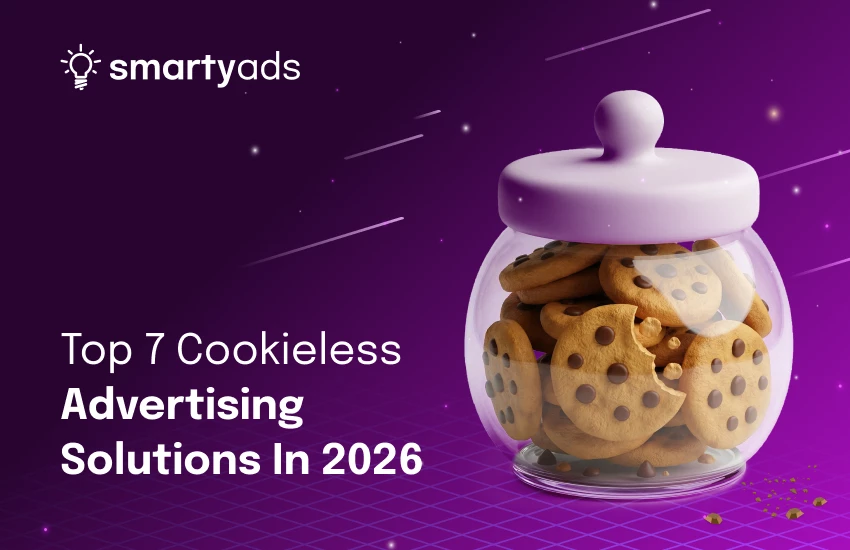
Google reversed its cookie phase-out plans in July 2024 and by April 2025 had shelved its Privacy Sandbox initiative entirely (Digital Commerce 360). Cookies are staying in Chrome — for now. But the share of cookieless environments keeps growing regardless: Safari and Firefox have blocked third-party cookies by default for years, iOS ATT slashed mobile tracking consent rates, and nearly 47% of the open internet is already unreachable via third-party cookies.
By 2026, advertisers who diversified early are running more resilient campaigns — and many have found that cookieless ads solutions simply outperform cookie-based targeting on measurable KPIs. Today we'll review this topic and discover how SmartyAds demand-side platform aptly solves this puzzle.
What Cookieless Advertising Actually Means in 2026
"Cookieless" doesn't mean untargeted. It means targeting and measuring campaigns without depending on third-party cookie data dropped in users' browsers by domains other than the site they're visiting.
The two types of cookies — and why only one is in question
First-party cookies set by the website you're on (remembering your login, your cart, your language preference) aren't going anywhere. Third-party cookies are set by outside domains — ad networks, analytics providers, data brokers — to track user behavior across many different sites. It's this cross-site tracking infrastructure that regulators, browsers, and consumers have pushed back against, and that is genuinely losing ground across the industry regardless of what Chrome does.
Why third-party cookie reach is eroding
Firefox and Safari collectively hold a significant share of desktop and mobile browser traffic. Apple's ATT framework — which since 2021 requires explicit opt-in for cross-app tracking on iOS — led to low consent rates and contributed to a ~30% drop in Meta's stock price in 2022, demonstrating exactly what happens when user consent is actually required. The GDPR in Europe and CCPA/CPRA in California have also raised the legal bar for using behavioral data for ad targeting. Even in Chrome, Google is expected to eventually introduce user-choice prompts for cookie consent, and the industry consensus — shared by analysts at Forrester — is that cookie-reliant audiences will continue to shrink over time regardless of the formal deprecation timeline.
Key Criteria for Choosing Cookieless Advertising Solutions
Before picking any specific platform or tactic, here's what should actually matter in your evaluation.
Privacy-first data collection
Your solution needs to be built for consent by design, not retrofitted. That means it either doesn't collect personal data at all (contextual advertising), collects it with explicit consent under GDPR/CCPA frameworks (first-party data platforms), or processes it in anonymized, aggregated environments (data clean rooms). Anything that relies on fingerprinting, hashed emails without proper consent flows, or opaque identifier graphs carries real regulatory risk.
Targeting accuracy and scale
Some cookieless alternatives (like pure contextual) sacrifice individual-level precision for scale and compliance; others (like first-party data activation) maintain precision but require significant audience-building investment. Evaluate fit against your campaign goals: prospecting vs. retargeting, awareness vs. conversion. There's rarely a single cookieless ads solution that does everything well.
Compatibility with programmatic advertising
The best cookieless programmatic advertising setups connect to real-time bidding infrastructure without requiring individual-user identity. That means your solution should support integration with demand-side platforms (DSPs) and supply-side platforms (SSPs) through standardized signals — contextual page data, deal IDs, cohort-level audiences — rather than user-level cookie syncing. Platforms that have invested in cookieless programmatic capabilities natively, rather than bolting them on, will outperform in yield and fill rate.
Measurement, attribution, and analytics
Cookie-based last-click attribution models break in cookieless environments. Look for platforms that support incrementality testing, modeled conversions, media mix modeling, or data clean room-based attribution — these approaches produce more accurate results and hold up regardless of future browser changes.
Integration with your existing ad tech stack
A cookieless solution that requires rebuilding your entire data infrastructure from scratch will take 12–18 months to show results. Prioritize solutions that work with your current CRM, CDP, consent management platform, and analytics stack. The transition works best when it's incremental and measurable, not a wholesale replacement.
Best 7 Cookieless Advertising Solutions in 2026
#1 SmartyAds Programmatic Platform (DSP + SSP)

SmartyAds operates a full-stack programmatic ecosystem — DSP for advertisers, SSP for publishers — that has built cookieless capabilities directly into its core bidding infrastructure. Contextual targeting, AI-powered bid optimization, and integrations with LiveRamp and Eyota enable data-driven targeting without relying on third-party cookie syncing across the open web. SmartyAds supports omnichannel campaigns (mobile, CTV, desktop, DOOH, audio) from a single platform, making it practical to run cookieless ads strategy consistently across formats.
Key features: AI/ML bid optimization, contextual targeting, header bidding support, LiveRamp identity integration, cross-channel reach (CTV, mobile, DOOH, audio), full supply transparency.
Strengths: Full-stack control from one vendor reduces data loss between DSP and SSP; contextual + first-party data pathways give advertisers flexibility without depending on any single identity solution.
Limitations: Self-serve nature requires some learning curve; less suitable for teams that need fully managed services.
#2 Contextual Advertising Platforms
 Contextual advertising — placing ads based on the content of the page rather than the profile of the user — is the most structurally privacy-compliant cookieless ads alternative available. It requires no personal data and no identifier at all. Modern contextual platforms have moved well past basic keyword matching: today's technology uses NLP and computer vision to understand page sentiment, topic depth, brand safety signals, and real-time intent signals. Research from ExchangeWire shows that contextual ads are 93% more memorable than mismatched ads, and 32% of consumers are more likely to act on contextually relevant placements.
The global contextual advertising market was valued at approximately $225 billion in 2025 and is projected to grow at a CAGR of 11.2% through 2030, per Research and Markets. That growth is driven almost entirely by privacy-first advertiser demand. Notable platforms in this space include Seedtag, Permutive, and GumGum, as well as contextual capabilities built into SmartyAds DSP and most major programmatic platforms.
Strengths: GDPR/CCPA compliant by design, no data infrastructure investment required, effective for brand awareness and mid-funnel campaigns.
Limitations: Less precise for retargeting or lower-funnel conversion campaigns without additional data layers; requires careful creative-to-context matching to perform well.
#3 First-Party Data Activation Platforms
 First-party data — information collected directly from your own customers and prospects with their explicit consent — has become the most strategically important asset in cookieless marketing. Customer data platforms (CDPs) like Segment, Bloomreach, and Adobe Experience Platform let advertisers unify, clean, and activate this data for targeting, lookalike modeling, and personalization across channels. According to Salesforce, 73% of consumers expect personalized experiences, but on terms of transparency — making consented first-party data activation the right balance between personalization and privacy. Separately, first-party data is considered the most critical personalization tool by 78% of businesses.
Strengths: The highest-quality targeting data available; consent-first by definition; enables attribution and measurement without third-party dependencies.
Limitations: Requires investment in data collection infrastructure (loyalty programs, registration flows, CRM integrations); audience size is constrained to your existing customer and prospect base without external data enrichment.
#4 Data Clean Rooms
 A data clean room is a privacy-safe environment where two or more parties — for example, a brand and a publisher — can match and analyze audience data without either party exposing raw user-level records to the other. The advertiser brings their CRM data; the publisher brings their authenticated audience data; the clean room computes overlaps and insights without raw data leaving either party's control. This enables publisher audience targeting and measurement that's more accurate than contextual alone, while remaining GDPR-compliant. Major platforms include AWS Clean Rooms, Google Ads Data Hub, Snowflake Data Clean Room, and InfoSum (recently acquired by WPP, signaling how central this infrastructure has become). The global data clean room market reached $1.42 billion in 2024 and is projected to grow at a CAGR of 22.1% through 2033.
Strengths: Enables rich audience matching and attribution without exposing personal data; increasingly supported by publishers for direct deals and retail media.
Limitations: Requires technical setup and data governance work on both sides of any collaboration; most valuable when you already have substantial first-party data.
#5 Universal IDs and Identity Solutions
 Universal ID solutions attempt to replace the cross-site tracking role of third-party cookies with a privacy-compliant, consent-based identifier. The most widely adopted is The Trade Desk's Unified ID 2.0 (UID2), which uses hashed and encrypted email addresses shared with user consent. LiveRamp's RampID and Lotame's Panorama ID work similarly. These IDs persist only where users have authenticated (logged into a publisher site with their email), so their reach is narrower than cookie-based tracking but their data quality is considerably higher — authenticated users are real, identified, consented individuals.
Strengths: Enables cross-publisher audience matching with consent; integrates into programmatic bidding infrastructure; higher-quality data than probabilistic cookie-based audiences.
Limitations: Reach is limited to authenticated inventory; depends on publisher adoption; GDPR compliance varies by implementation and requires careful consent management.
#6 Server-Side Tracking and Analytics
 One often-overlooked cookieless solution is moving measurement server-side. Traditional JavaScript pixels are increasingly blocked by ad blockers and privacy browsers. Server-side tracking moves the measurement logic to your own server: when a user converts, your server sends the event data directly to the ad platform's API — Google Enhanced Conversions, Meta CAPI, etc. — rather than relying on a browser pixel. This dramatically improves attribution accuracy without depending on cookies for conversion tracking. Most major ad platforms have built server-side APIs specifically for this purpose.
Strengths: Measurably improves conversion tracking accuracy; largely unaffected by ad blockers or browser restrictions; supported by all major ad platforms.
Limitations: Requires technical implementation; a measurement improvement, not a targeting solution — it doesn't expand reach but it does reveal reach you were already getting and undercounting.
#7 AI-Driven Probabilistic Targeting
 AI-powered probabilistic models infer audience characteristics and intent from aggregated behavioral patterns — device signals, time-of-day patterns, content consumption sequences, geographic data — without individual-level cookie tracking. These models identify high-probability audience segments rather than individuals. Platforms like Lotame and various DMP-based solutions use this for prospecting campaigns on cookieless inventory where no authenticated signal exists.
Strengths: Scales to cookieless inventory at large; improves prospecting reach without personal data requirements.
Limitations: Lower precision than deterministic targeting; harder to validate and audit; not suitable for regulated industries where explicit consent is required for all profiling.
Here is a brief comparison of approaches:
| Solution | Best for | Cookie dependency | Key benefit |
| Contextual targeting | Relevant reach | None | Content-based relevance |
| First-party data | Existing audiences | None | High audience relevance |
| Cohort targeting | Scaled campaigns | Low | Privacy-friendly reach |
| Identity solutions | Addressable audiences | Varies | Cross-site targeting |
How to Transition From Cookie-Based to Cookieless Advertising
Most advertisers approach this as an all-or-nothing switch, which is where they lose months and budget unnecessarily. A phased diversification works better in practice.
Audit your current advertising strategy
Map every campaign, data source, and attribution model against its dependency on third-party cookies. Which retargeting pools rely on browser-set pixels? Which audience segments come from third-party data providers? Most advertisers discover that significant traffic — Safari, Firefox, iOS app — is already operating in a cookieless environment but invisible to their attribution model. That's the gap you're starting to close.
Prepare first-party data infrastructure
Implement or upgrade a consent management platform (CMP) that meets GDPR/CCPA requirements. Build authentication and registration flows on owned properties. Consolidate customer data into a CDP that can feed targeting systems. Even a modest first-party audience compounds over time and becomes the anchor for lookalike models and data clean room collaborations.
Test and scale cookieless solutions gradually
Run cookieless and cookie-based campaigns in parallel using incrementality tests or media mix modeling to measure actual contribution. Start with contextual advertising as the lowest-friction entry point. Add server-side tracking to fix measurement gaps. Layer in first-party data activation as your consented audience grows. Scale what demonstrates real lift.
Redefine measurement and attribution
Build attribution models that function without complete cross-site cookie data: incrementality testing, modeled conversions, and media mix modeling. These approaches take more upfront work but produce fundamentally more accurate results than last-click attribution ever did — and they survive any future privacy changes.
Cookieless approaches: So, which one to choose?
| Approach | Targeting method | Best for | Main limitation |
| Contextual targeting | Content, keywords, IAB categories | Reaching users by content relevance | Less precise than user-level targeting |
| First-party data | Owned customer and behavioral data | Existing audiences & retargeting | Requires sufficient first-party data |
| Cohort targeting | Groups users by shared interests or behavior | Scaled audience targeting | Less individual-level precision |
| Identity solutions | Privacy-focused identifiers | Addressable audience reach | Availability varies by browser and ecosystem |
| Geographic targeting | Location signals | Local and regional campaigns | Limited audience granularity |
How SmartyAds DSP supports privacy-friendly advertising
SmartyAds DSP supports contextual targeting based on keywords and IAB categories, allowing advertisers to match ads with relevant content without relying solely on individual user tracking. Its contextual targeting module uses AI and machine learning to analyze page content and help place ads in relevant environments.
For advertisers adapting to a cookieless environment, this provides a practical way to maintain content relevance and targeting control while reducing dependence on third-party cookies.
Case Study: Titan Sunrooms
Titan Sunrooms used SmartyAds DSP to extend its reach beyond Google and Facebook while maintaining control over targeting and campaign costs. After optimizing supply sources and geo-targeting across its service area, programmatic campaigns grew to approximately 20% of the company's website traffic and contributed a similar share of total sales. The campaign also became a scalable channel that the company continued to invest in for more than two years. Check the full case study.
How to get started?
Getting started doesn't have to be complicated. With SmartyAds DSP, you can:
- Choose your campaign goal and audience.
- Select the right cookieless targeting approach and ad formats.
- Launch your campaign through the SmartyAds platform.
- Monitor and optimize performance based on campaign results.
This lets you adapt your advertising strategy to a privacy-first environment while keeping targeting and campaign performance under control.
Conclusion
Third-party cookies haven't disappeared from Chrome, but their structural relevance to digital advertising is declining regardless — through browser restrictions, regulatory pressure, user consent behavior, and a measurable shift in where quality audiences actually live. The best cookieless advertising solutions in 2026 aren't theoretical workarounds. They're mature, live infrastructure that many leading advertisers already rely on as their primary channel. Smart cookieless marketing solutions combine multiple approaches: contextual advertising for scalable, privacy-compliant reach; first-party data and clean room-based matching for precision; and server-side measurement to see the full picture.
A well-executed cookieless advertising strategy — one built on diversification rather than dependence on any single identifier — is more durable than any cookie-based setup. Advertising solutions for the cookieless open web exist, they work, and they're improving faster than the cookies they're designed to complement or replace.
FAQ
There's no single best answer — it depends on your campaign goals. For awareness and reach at scale, contextual advertising is the most compliant and scalable option. For precise retargeting and personalization, first-party data activation delivers the strongest results. For omnichannel programmatic campaigns, a full-stack platform like SmartyAds DSP combines contextual targeting, AI optimization, and identity integrations in one place. Most high-performing strategies in 2026 use at least two approaches together.
Yes — and in many cases better ROI than cookie-based campaigns. Contextual ads are 93% more memorable than mismatched placements, and first-party data targeting delivers higher conversion rates because the audience is directly consented and accurately identified. The main adjustment is building the right measurement framework — server-side tracking and incrementality testing — to capture performance that cookie-based attribution was previously missing.
Most cookieless advertising alternatives are more compliant than traditional third-party cookie-based targeting, not less. Contextual advertising requires no personal data processing at all. First-party data collected under proper consent flows, data clean rooms, and server-side tracking are all designed to meet GDPR, CCPA, and similar standards. The key is ensuring your CMP and consent infrastructure are correctly implemented — the technology itself is privacy-first by design.