

Hand a client's budget to the wrong DSP and you'll spend the next three months explaining why. Agencies juggling several accounts at once don't have room for a platform that buries campaign controls behind an account manager or locks meaningful optimization behind a six-figure minimum. This guide breaks down the self-serve demand-side platforms agencies actually run client budgets through in 2026 — what each one costs to get into, who it's built for, and where it falls short. Platforms like SmartyAds DSP sit at the accessible end of that spectrum, and we'll show exactly where it and five other major players land on price, channels, and control.
Key takeaways:
- Self-serve DSPs put targeting, bidding, and reporting directly in the media buyer's hands — no waiting on an account manager to make a change.
- Minimum spend is the single biggest gatekeeper: agency budgets on this list range from $1,000 to $300,000+ per month depending on the platform.
- StackAdapt and SmartyAds DSP offer the lowest realistic entry points for agencies still building out programmatic client rosters.
- The Trade Desk and DV360 deliver the deepest inventory and identity tools but assume real programmatic fluency and real budget.
- Amazon DSP dropped its self-serve minimum in late 2025, opening retail-media-adjacent campaigns to smaller agencies.
- Multi-client account structures, white-label options, and API access matter as much as targeting depth once an agency manages more than a handful of advertisers.
- No single DSP wins every use case — most agencies that scale past a few clients end up running two platforms side by side.
What Is a Self-Serve DSP?
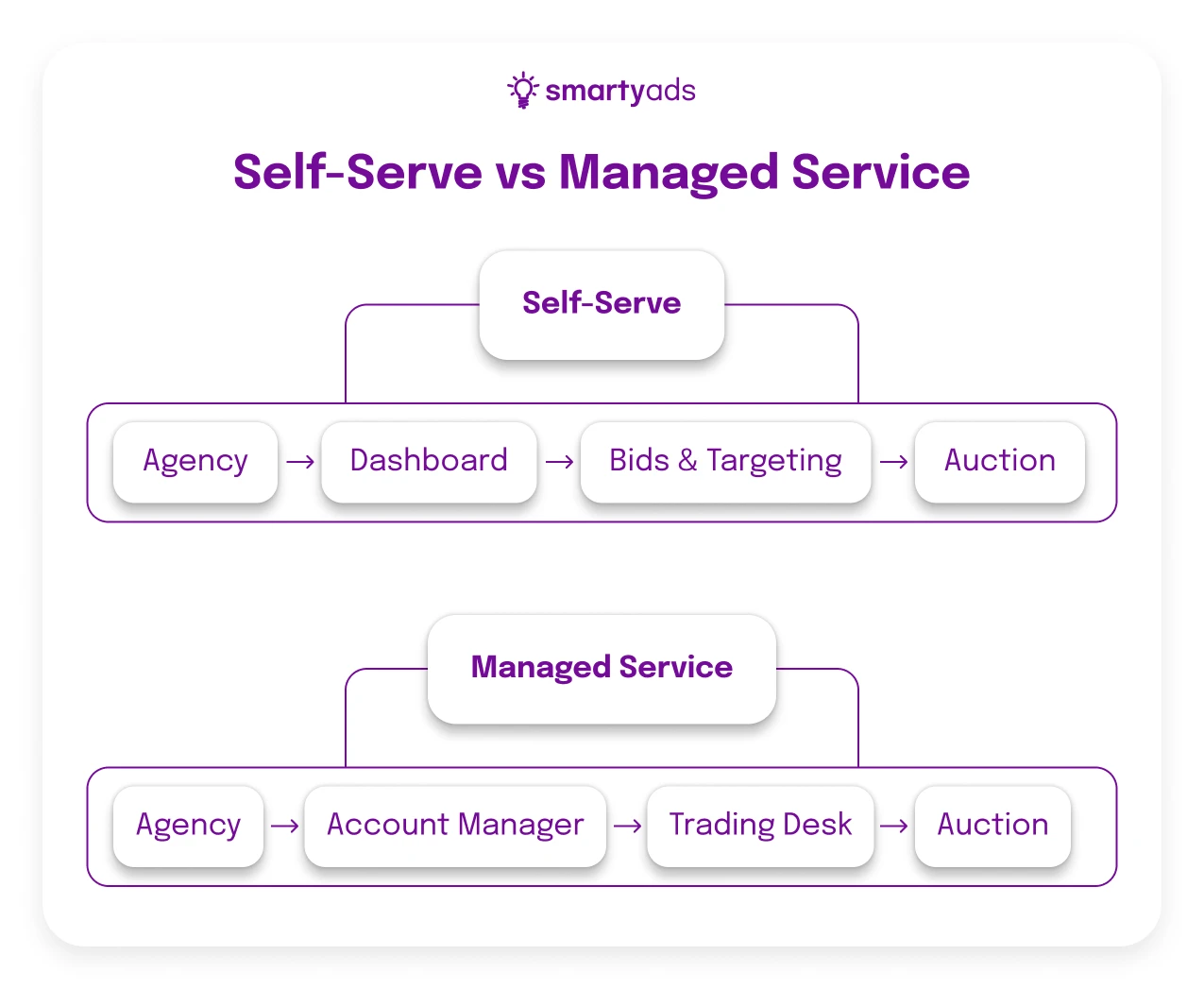
A self-serve DSP is a demand-side platform where the agency — not the vendor's account management team — builds campaigns, sets bids, uploads creative, and pulls reports directly through the platform's dashboard. It sits on the buy side of real-time bidding: the agency's line items compete in auctions run by supply-side platforms and ad exchanges, and the DSP places bids automatically based on the targeting and budget rules the buyer configures.
That's the opposite of a managed-service arrangement, where a vendor's trading desk builds and runs the campaign on the agency's behalf, usually in exchange for a much higher minimum spend and a management fee layered on top of media cost. Self-serve doesn't mean unsupported — most platforms on this list offer onboarding help, a knowledge base, or an account manager for account-level questions — but the agency keeps its hands on the actual programmatic media buying controls.
In practice, few platforms are purely one or the other. Most DSPs blend self-serve tools with optional managed layers that kick in as an agency's spend grows, which is why the same platform can look "self-serve" to a $2,000/month client and "hybrid" to a $200,000/month one.
Why Agencies Choose Self-Serve DSPs
Margin, honestly. When a managed-service DSP runs the campaign, the agency pays a markup on top of media cost for work it could otherwise bill the client for — or pocket to make the account more profitable. Self-serve puts the agency's own trader in the driver's seat: setting targeting, testing creative, adjusting bids in real time, instead of filing a change request and waiting for someone else to make it.
The numbers back this up. Global ad spend topped $1 trillion in 2025, up 10.5% year over year, and somewhere inside that growth, agencies lost an estimated $26.8 billion to hidden fees and unclear supply-path markups, per eMarketer figures cited by SmartyAds' own DSP team. That's the gap self-serve access is meant to close — the space between what a client pays and what an agency can actually point to on a report.
Self-serve also hands agencies:
- Direct control over pacing and bids — see underperformance, fix it, no waiting on anyone else.
- Visible supply paths — the agency knows which exchanges and SSPs its impressions come from, instead of trusting a trading desk's summary.
- A lower entry cost per client — useful when testing programmatic on a new account before committing a real budget.
- Multi-client account structures — campaigns, budgets, and reporting stay cleanly separated as the roster grows.
- Faster creative turnaround — especially on platforms with a built-in creative studio instead of a separate design queue.
.webp)
Struggling to justify programmatic fees to a client who's watched budget disappear into a managed service black box? Talk to the SmartyAds team about agency account access →
How We Evaluated the Platforms
We compared each DSP across the seven criteria agencies actually run into once they're managing more than one client account:
- UX — how much programmatic experience a trader needs before they can run a campaign competently
- Targeting — first-party, third-party, contextual, and lookalike options, plus data partner integrations
- Inventory — number and quality of SSP connections, direct publisher deals, and channel coverage (display, video, native, audio, CTV, DOOH)
- Reporting — analytics depth, log-level data access, and whether custom reporting is available without an enterprise contract
- AI optimization — automated bidding, predictive analytics, and campaign-planning assistance
- Pricing — minimum spend, platform fees, and whether costs are transparent or negotiated
- Support — onboarding quality, account manager access at entry-level budgets, and self-service documentation
Every platform below was evaluated against agency use cases specifically, not brand-side or performance-marketer use cases, since the operational needs — multi-client billing, white-label reporting, seat-based user roles — differ meaningfully.
Comparison Table
| SmartyAds DSP | Agencies scaling mid-market client budgets | Full self-serve, $1,000 minimum deposit | Display, video, native, audio, in-app, CTV/OTT, DOOH | Low entry cost, AI adaptive bidding, LiveRamp & Eyeota data integrations, agency multi-account access |
| StackAdapt | Native, CTV, and multichannel agencies | Self-serve, ~$5,000/mo recommended | Native, display, video, CTV, audio, DOOH, in-game | Intuitive UI, top-rated customer support, built-in creative studio |
| The Trade Desk | Enterprise agencies with open-web scale | Self-serve UI, but $25K–$50K+/mo practical floor | Display, video, CTV, audio, DOOH | Premium publisher access, Kokai AI bidding, UID2 identity |
| DV360 | Agencies embedded in the Google ecosystem | No true self-serve; GMP contract required, ~$50K/mo | Display, video, YouTube, CTV, audio | YouTube and Google Ads data, 90+ exchange access, cross-device identity |
| Adform | EMEA agencies wanting DSP + ad server in one stack | Hybrid; self-serve via direct or reseller access | Display, video, CTV, audio, DOOH | Native ad server, 300+ data and inventory partnerships |
| Amazon DSP | Agencies running retail and e-commerce clients | Self-serve, no Amazon-imposed minimum since late 2025 | Display, video, audio, Prime Video, Twitch, Fire TV | First-party shopper data, streaming inventory, Amazon Marketing Cloud |
In this shortlist view, SmartyAds DSP is the only platform combining a four-figure entry deposit with full self-serve control across CTV, DOOH, and web-to-app — most competitors that undercut it on price also cut channel coverage or targeting depth to get there.
Not sure which of these fits your client roster? See SmartyAds DSP pricing and self-serve setup →
Top Self-Serve DSPs for Agencies
SmartyAds
Overview: SmartyAds DSP is a full-stack self-serve platform built for agencies and brands running cross-channel programmatic without an enterprise-sized budget. Campaigns can launch with a $1,000 prepayment, and the platform's AI-driven adaptive bidding adjusts bid floors in real time against live auction data to keep win rates competitive without overpaying. Agencies get a dedicated multi-account structure for managing multiple clients from one login, along with LiveRamp and Eyeota data integrations for audience targeting that doesn't rely on a single walled-garden dataset.
Expert tip from SmartyAds: Dmytro Sekiro, Head of DSP at SmartyAds, notes that the shift agencies are making in 2026 isn't about chasing more impressions — it's about being able to answer exactly where a client's budget went, down to the supply path. Fee transparency, not reach, is becoming the deciding factor when agencies choose a long-term DSP partner.
Best for: Agencies running several mid-market clients that want their hands directly on targeting, bids, and creative — without committing to a six-figure budget first.
Pros:
- A $1,000 minimum means you can bring on a new client without betting the account on it
- Handles CTV/OTT, DOOH, and web-to-app traffic alongside standard display and video
- Creative studio and AI bidding are built in, so you're not stitching together outside tools
- One dashboard, multiple clients — the agency account structure keeps them separate without separate logins
Cons:
- Analytics sit at an intermediate level, not enterprise. Teams that need log-level, placement-by-placement breakdowns will find The Trade Desk or Adform go deeper
- White-label is no longer part of the core DSP — it now lives under a separat SmartyAds-affiliated brand
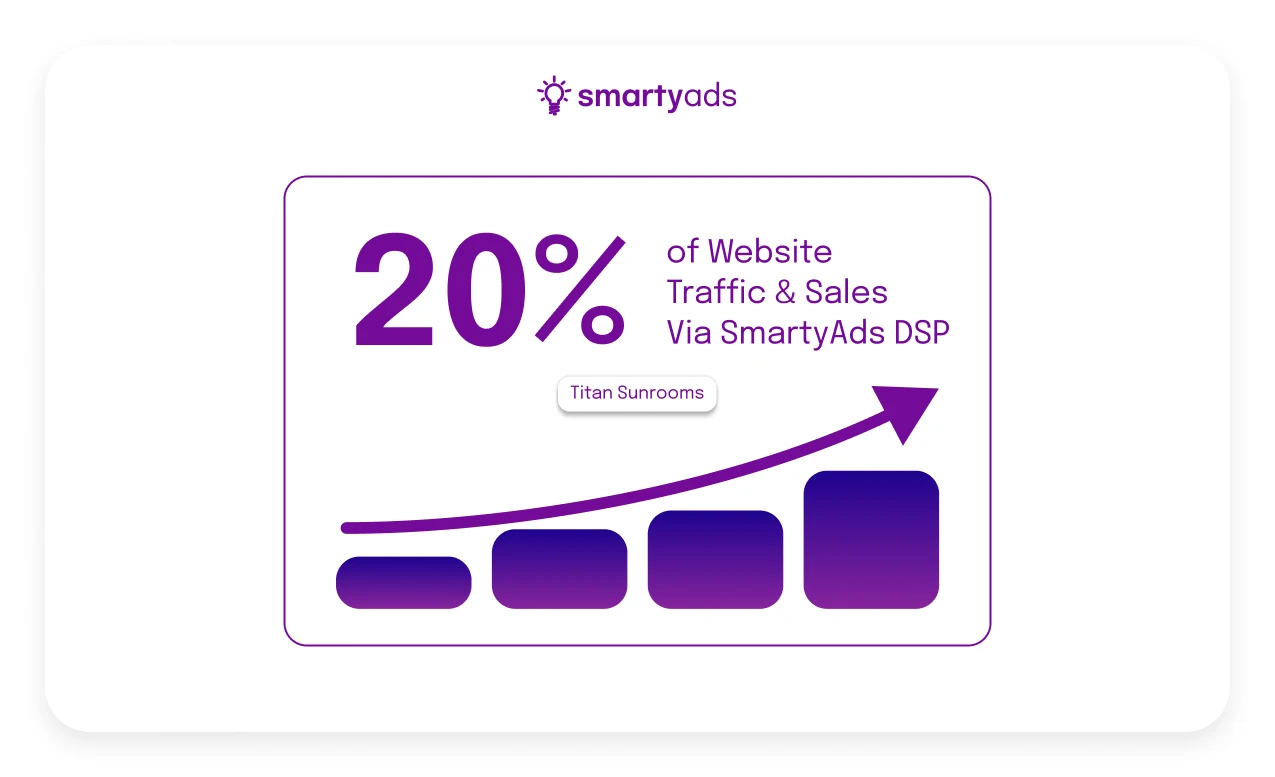
Agencies weighing whether the lower entry cost holds up in practice don't have to take that on faith. Titan Sunrooms, a home-improvement company running lead-gen campaigns beyond Google and Facebook, moved a growing share of budget into SmartyAds DSP after early testing showed cost-efficient clicks the team wasn't seeing elsewhere. As CMO Larry Genkin put it, the platform delivered "cost-effective clicks, much better than what we were seeing with other programmatic platforms." Today, roughly 20% of the company's website traffic — and a comparable share of sales — traces back to SmartyAds programmatic campaigns. Read the full case study →
StackAdapt
Overview: Ask around, and StackAdapt is usually the answer when someone wants a DSP that doesn't need a week of training first. It puts native, display, video, CTV, audio, DOOH, and in-game inventory in one place, and leaves the predictive bidding, bid shading, and campaign planning to its own optimization layer instead of your trader. There's no minimum spend on paper, but $5,000 a month is roughly where agencies start seeing it pay off — and on G2, no major DSP beats its support score: 9.9 out of 10.
Best for: Independent and mid-market agencies that need something running fast, want real native and CTV coverage, and aren't after enterprise-scale reach.
Pros:
- No spend floor, no lock-in — the pricing is exactly what it says
Native and content-discovery inventory earns its reputation, thanks to direct publisher deals
Teams new to programmatic keep giving the onboarding and support high marks
Cons:
- The budget it actually takes to see results is still above SmartyAds' entry point
- Cross-platform attribution and some identity features haven't caught up to what Basis or Adform offer
The Trade Desk
Overview: The Trade Desk is the biggest independent DSP on the open web, running on its Kokai bidding engine and the UID2 identity framework. Its direct publisher relationships — Hulu, Disney, Spotify, and others — give it some of the deepest CTV, audio, and video inventory around. The catch is what it costs to get in: real self-serve access usually starts at $25,000–$50,000 a month through an agency or partner, direct enterprise deals can climb into six figures per quarter, and the platform takes roughly 20% of gross spend off the top.
Best for: Larger agencies managing enterprise or upper-mid-market brands with the budget and in-house programmatic expertise to run a complex, fully independent DSP.
Pros:
- No independent DSP touches its CTV and audio inventory for breadth
- Once you're in, the fee structure is itemized and easy to follow
- UID2 gives more room to work with identity than walled-garden platforms allow
Cons:
- The minimum spend rules out smaller agency accounts before they even get started
- Kokai's interface is built for a trained programmatic trader — a generalist buyer will need real ramp-up time
DV360
Overview: Google's Display & Video 360 isn't technically self-serve in the way the other platforms on this list are — access requires a Google Marketing Platform contract or a certified reseller relationship, and there's no sign-up-this-afternoon option. What agencies get in exchange is unmatched access to YouTube inventory, Google's first-party audience data, and 90-plus ad exchanges, all inside one interface with genuine cross-device identity resolution. Practical minimums land around $50,000 per month once platform fees are factored in.
Best for: Agencies already embedded in the Google ecosystem that need YouTube and cross-device reach alongside open-web programmatic.
Pros:
- Unrivaled access to YouTube and Google's owned-and-operated inventory
- Strong first-party audience data without third-party dependency
- Deep integration with the rest of the Google Marketing Platform stack
Cons:
- No genuine self-serve tier — every account runs through a partner or direct Google relationship
- Pricing is bundled and less transparent than independent DSPs
Adform
Overview: Adform is a European full-stack ad-tech company offering a DSP alongside its own ad server, which lets agencies skip the separate ad-serving fees that come with most other platforms on this list. It's a hybrid model: agencies can get self-serve dashboard access directly or through certified resellers, with more than 300 data and inventory partnerships spanning header bidding-connected supply and direct publisher deals, particularly strong across EMEA markets.
Best for: EMEA-focused agencies that want DSP and ad-server functionality combined, without paying for two separate systems.
Pros:
- The ad server is built in, so that's one line item you don't have to pay separately
- Publisher and data partnerships across EMEA run deep
- Full API access lets agencies build their own reporting on top instead of settling for the default
Cons:
- Direct self-serve access is there, but reseller partners get most of the spotlight — expect a bit more friction getting set up on your own
- Outside Europe, the inventory thins out compared to global-first competitors
Amazon DSP
Overview: Amazon DSP gives agencies programmatic access to Amazon's retail and streaming ecosystem — Prime Video, Twitch, Fire TV, and Amazon.com placements — powered by first-party shopping and browsing data that no other DSP can replicate. Amazon removed its self-serve spend minimum in late 2025, though agencies typically need $5,000–$10,000 per month in spend before the platform's predictive targeting has enough signal to perform well. Managed service, run by an Amazon Ads account team, still starts around $50,000 per month.
Best for: Agencies running retail media, e-commerce, or CPG clients that want Amazon's shopper data tied directly to display, video, and streaming placements.
Pros:
- Purchase and browsing data straight from Amazon — no other DSP has access to this
- The self-serve tier no longer has an Amazon-imposed spend floor
- Direct line into Prime Video and Twitch streaming inventory
Cons:
- Self-serve demands real programmatic know-how, or you'll burn through budget before there's enough conversion signal to work with
- Reporting and targeting shine for Amazon-native retail plays but lose their edge for brand-awareness campaigns outside Amazon's ecosystem
How to Choose the Right DSP for Your Agency
There's no single "best" platform on this list — the right choice depends on client mix, budget tiers, and how much programmatic depth your team already has in-house. Work through these questions in order:
- What can you realistically spend per client to start? If most new accounts come in under $5,000/month, The Trade Desk and DV360 aren't really an option yet — SmartyAds and StackAdapt fit that range without pushing you into a managed-service tier.
- What channels do your clients actually need? Running mostly CTV and streaming? Weight streaming ads inventory and CTV targeting more than raw exchange count.
- How much programmatic experience does your team have? Kokai (The Trade Desk) and DV360 assume a trained trader. Platforms with AI-assisted bidding and simpler dashboards cut the ramp-up time for a generalist buyer.
- Do you need multi-client structures and white-label reporting? Past roughly five active programmatic clients, this stops being optional.
- Fees or transparency — which matters more? Bundled pricing (DV360, managed-service Amazon DSP) is easier to quote a client but harder to audit than a flat, transparent fee.
- Would two DSPs serve your clients better than one? Plenty of mid-size agencies run a low-minimum platform for smaller accounts alongside a premium DSP for their biggest ones, instead of forcing everyone through the same door.
FAQ
With self-serve, the agency's own team builds and runs campaigns directly in the platform. With managed service, the DSP's trading desk does that work for you — usually at a higher minimum spend, plus a management fee on top.
Depends entirely on the platform. SmartyAds DSP asks for a $1,000 deposit. StackAdapt runs better once you're around $5,000/month. Amazon DSP's self-serve tier has dropped its minimum altogether. The Trade Desk and DV360, on the other hand, realistically want $25,000–$50,000+ a month before they're worth the setup.
Most platforms here support it, just not to the same degree. SmartyAds, StackAdapt, and Adform all have dedicated agency account features; DV360 goes further with a five-tier partner structure built specifically for managing several brands under one login.
Yes — bid adjustments, budget pacing, creative QA, all on you. In exchange, changes happen immediately and you can see exactly where a client's budget is going, which is a trade most agencies are happy to make once they have any in-house programmatic skill at all.
Only if reselling programmatic under your own brand is part of the business model. Otherwise, standard agency account access with client-level reporting covers what most agencies need.
Getting Started Is Simpler Than It Looks
If routing clients through a managed service has been the default for your agency because self-serve seemed like too big a leap, that calculation just got easier. SmartyAds DSP's self-serve tier opens with a $1,000 deposit — no long-term contract, no minimum client count required. Here's what getting started actually looks like:
- Create a free account and set up agency-level access for your clients
- Fund your first campaign with the $1,000 deposit
- Set your targeting, upload creatives through the built-in studio, and configure bidding rules
- Launch, then watch performance come in live from the dashboard
Start self-serve, and if a client's spend eventually outgrows what your team wants to manage alone, add managed support then — nothing here locks you into that decision upfront.
Conclusion
Picking a self-serve DSP really comes down to matching the platform's economics to how your agency actually works: budget per client, channel mix, and how much programmatic depth your traders already have. Get that match right, and campaigns launch faster, client reports get cleaner, and fewer dollars vanish into fees you can't explain on a call. SmartyAds DSP tackles the two things that stop most agencies before they even test programmatic — a low entry deposit and full self-serve control across CTV, DOOH, and standard display and video — without asking for a long-term contract or a dedicated trading desk. First programmatic client or fiftieth, the setup is built to get a campaign live in days, not weeks.
Request a SmartyAds DSP Demo → Talk to our team today
.webp)