

In 2026, 41% of mobile growth leaders face challenges with cross-channel attribution: 39% see an increase in data and measurement costs, and only 8% are able to get a consolidated view of app performance in different channels.
The same report shows us that 36% of mobile marketers report facing increased costs of acquiring users. More than 40% of them shift to context targeting as a response to privacy policy updates. This is why it is so critical to select the future-proof platform that is well adapted to the challenges of the mobile world.
We’ve prepared the guide that will help you to make the right choice in the plethora of options. You'll also see how solutions like SmartyAds DSP adapted its capabilities to efficiently meet the new requirements of the market.
Key takeaways:
- In-app inventory, and post-install optimization, privacy – all of those factors require a separate approach from traditional advertising, and thus a specialized DSP.
- The "best" DSP depends on campaign goals, so the key to success will be defining priorities upfront.
Automated bidding, AI optimization, contextual advertising – all of those are prioritized by advertisers right now. - Premium inventory often outweighs a bigger pool of general placements.
- There are DSPs that specialize in mobile and in-app, while the others offer omnichannel reach.
- Choosing the right DSP impacts many business outcomes, starting from overall campaign efficiency and ending with better return on ad spend, more effective bid price, and reduced ad budget.
Why mobile app advertising requires a specialized DSP
Mobile app ad campaigns are more complicated than display advertising campaigns.
The aim of mobile marketing is not just to generate impressions or clicks, but to get users who will download, install, go through the onboarding process and make purchases or become your loyal clients. In order to achieve that, you need to use some technologies that will optimize your campaigns beyond traffic numbers.
A mobile-focused DSP should support:
- Premium in-app inventory
- App install campaigns
- Post-install event optimization
- SKAdNetwork (SKAN) support
- AI-powered bidding
- Audience targeting
- Fraud prevention
- Measurement across devices
Tip from an Expert: Avoid the mistake of selecting a DSP solely based on CPI. Look also for decent post-install actions, such as purchases or other actions that the user performs.
Key features to look for in such DSP
Before comparing platforms based on real-time bidding, consider which features matter most for your business.
Premium In-App Inventory
Having good inventory affects how well your ads can be served to your target audience. Choose those platforms that are associated with premium publishers and various ad exchanges. Full-stack platforms (those like SmartyAds, that have their own infrastructure of solutions, including SSP), can also boast direct publishers and thus, direct verified good quality demand.
AI Optimization
Machine Learning assists marketers to automatically bid, budget, and target towards business objectives like installs, registrations, sales, or return on advertising spend (ROAS).
Audience Targeting
Contextual targeting, behavioral targeting, and finally geo-targeting – advertisers need them because they help you to find users more precisely. Those users will be more likely to download the app or interact with your ad.
Fraud Prevention
Invalid traffic and install fraud can quickly drain advertising budgets. Built-in fraud detection helps improve campaign quality while protecting ad spend.
Omnichannel Reach
Now many brands are not only using mobile. They can use those platforms which also have support for Connected TV (CTV interactive), display, digital audio and many other channels. In this way, advertisers can develop a more coherent customer journey.
Expert tip: Privacy regulations have significantly changed mobile attribution. Apple's SKAdNetwork along with privacy-safe optimization methods will be also very important to have in case you plan to maintain campaign performance on iOS.
Are there any data to back up my platform choice? We’ve gathered some stats around the subject that may influence your choice in as well:
| Stat | Insight |
| By 2027, more than 90% of best programmatic ad platforms on the market will be powered by AI. | Advertisers see 2.7x performance improvement after choosing AI-driven platforms. |
| Lookalike targeting increases overall targeting performance, so lead quality grows by 18–40%. | Meaningful and correct targeting increases the result of ad campaigns. So, the platform should have strong and data-driven targeting options. |
| More than 71% of CTV inventory is now sold programmatically. | Advertisers prefer to advertise in CTV apps and programmatically. |
| 41% of advertisers consider contextual targeting their primary tactic. | Advertisers choose DSPs that support contextual ads (privacy and data-related reasons). |
Comparison table of DSPs
We evaluated each DSP using the following criteria:
- Mobile inventory quality
- App install optimization
- AI bidding capabilities
- Fraud prevention
- Reporting and transparency
- Omnichannel capabilities
- Ease of use
- Scalability
| Platform | Best For | In-App Inventory | CTV Support | AI Optimization |
| SmartyAds demand-side platform | Omnichannel advertisers and agencies | + | + | + |
| Moloco | Performance marketing | + | Limited | + |
| Liftoff | Mobile user acquisition | + | No | + |
| AppLovin | Gaming advertising | + | Limited | + |
| StackAdapt | Omnichannel campaigns | + | + | + |
| Google DV360 | Enterprise advertisers | + | + | + |
Choosing the best platform will depend on your campaign objectives. While some DSPs may excel at performance marketing and mobile app installations, others are more appropriate for omnichannel ads and enterprise campaigns.
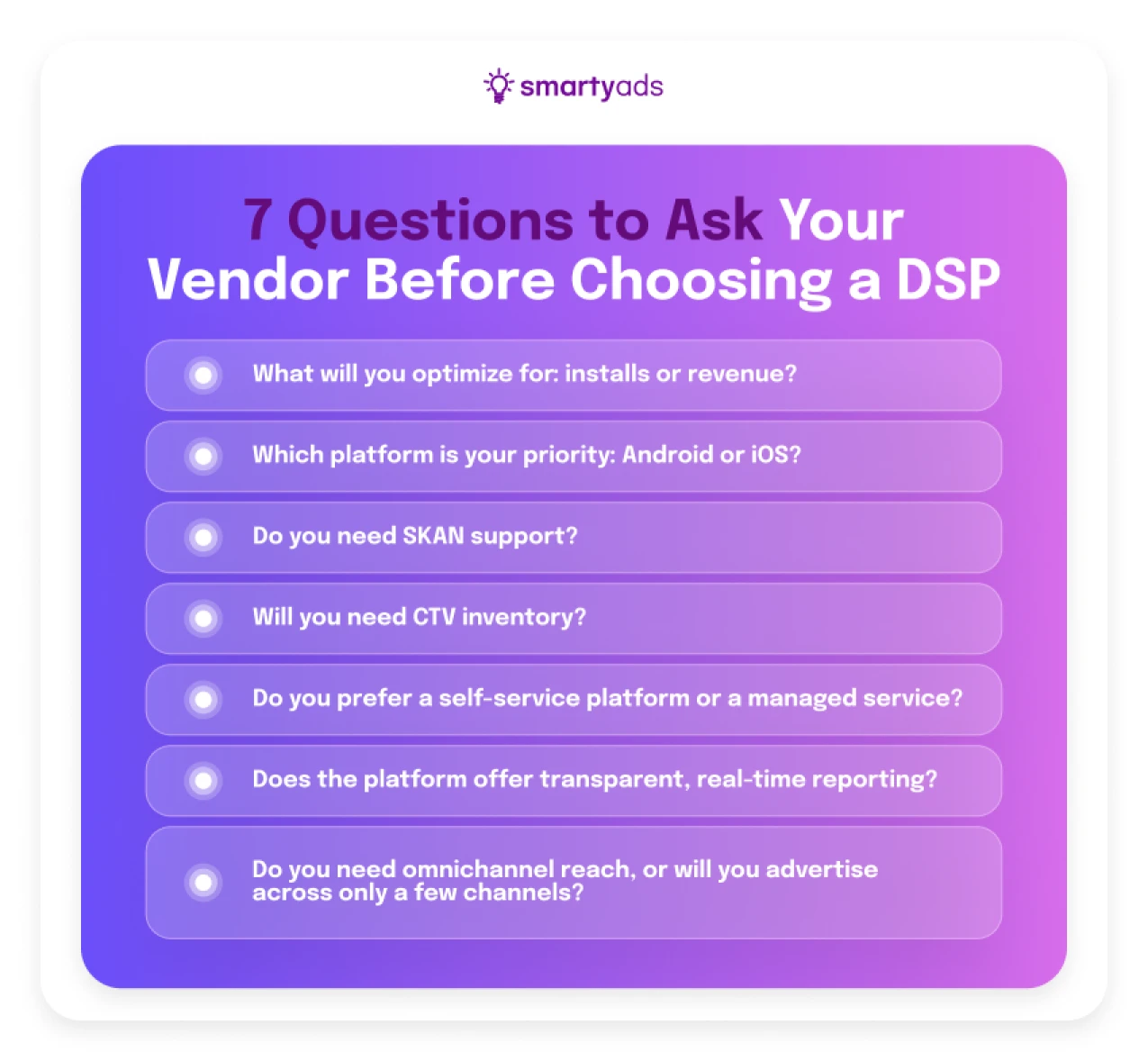
Before choosing your DSP for mobile app advertising, it is important to take into account your initial goals, as well as details such as:
- Installs vs revenue – what are you going to optimize?
- Android vs IOS – what will you prefer for advertising?
- SKAN support – is it essential for you?
- CTV traffic – will I need it?
- Am I comfortable with a self-service platform or managed one?
- What about transparent and real-time reporting?
- Do I really need an omnichannel reach or will I be working with a limited number of channels?
Best mobile DSPs
SmartyAds DSP
 Best for: DSP from SmartyAds is a demand-side platform where advertisers can buy premium inventory in mobile apps and web, CTV, DOOH, audio, and display advertising within a single solution. This solution for programmatic media buying is award-winning (EVA, Stevie awards, Red Herring and more, see the full list of awards in the footer).
Unlike mobile-first DSPs that work only for mobile app installs, SmartyAds enables advertisers to conduct campaigns in various digital media channels and maximize their efficiency with the help of AI technologies.
Key Features
- Premium in-app inventory
- AI-powered bid optimization and CPM optimization (Adaptive CPM)
- Contextual and audience targeting
- Cross-device targeting
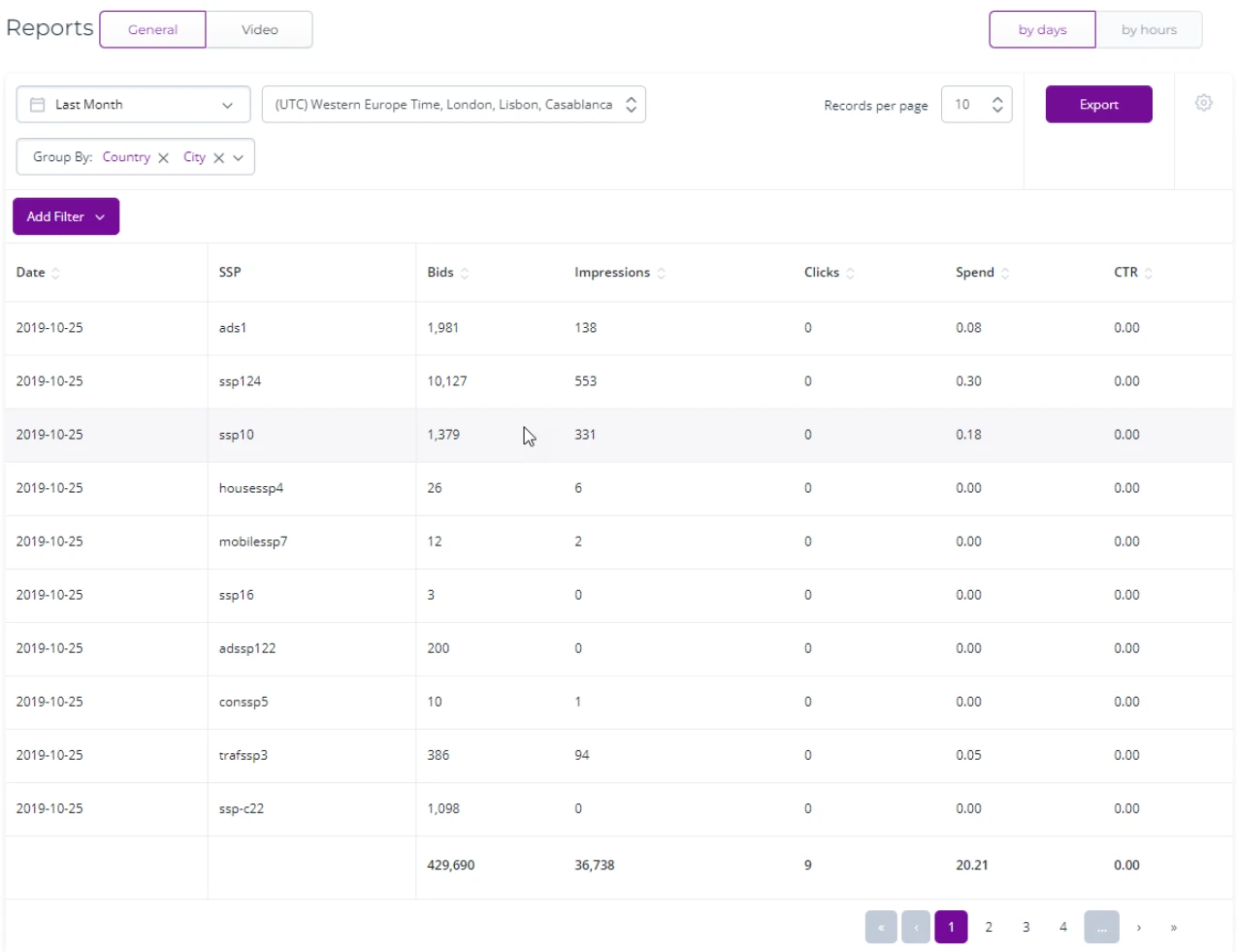
- Real-time analytics
- Omnichannel campaign management
- Opportunity to serve web-to-app and other types of omnichannel campaigns
- In-built creative builder to let you construct creatives in seconds
- Integration with known DMPs for additional targeting capabilities (LiveRamp and Eyeota).
Advantages
- Easy-to-use interface
- Transparent reporting
- Supports multiple campaign objectives
- Suitable for agencies and in-house teams
- Global inventory across numerous ad exchanges
Limitations
It is a self-serve DSP – dedicated account managers will help you set up your campaigns correctly, but you still need to have time to operate the campaigns.
Best Use Cases
SmartyAds is well suited for:
- Mobile app advertisers
- Retail brands
- eCommerce companies
- Fintech apps
- Travel businesses
- Agencies managing multiple clients
- Brands planning to expand into CTV or omnichannel advertising
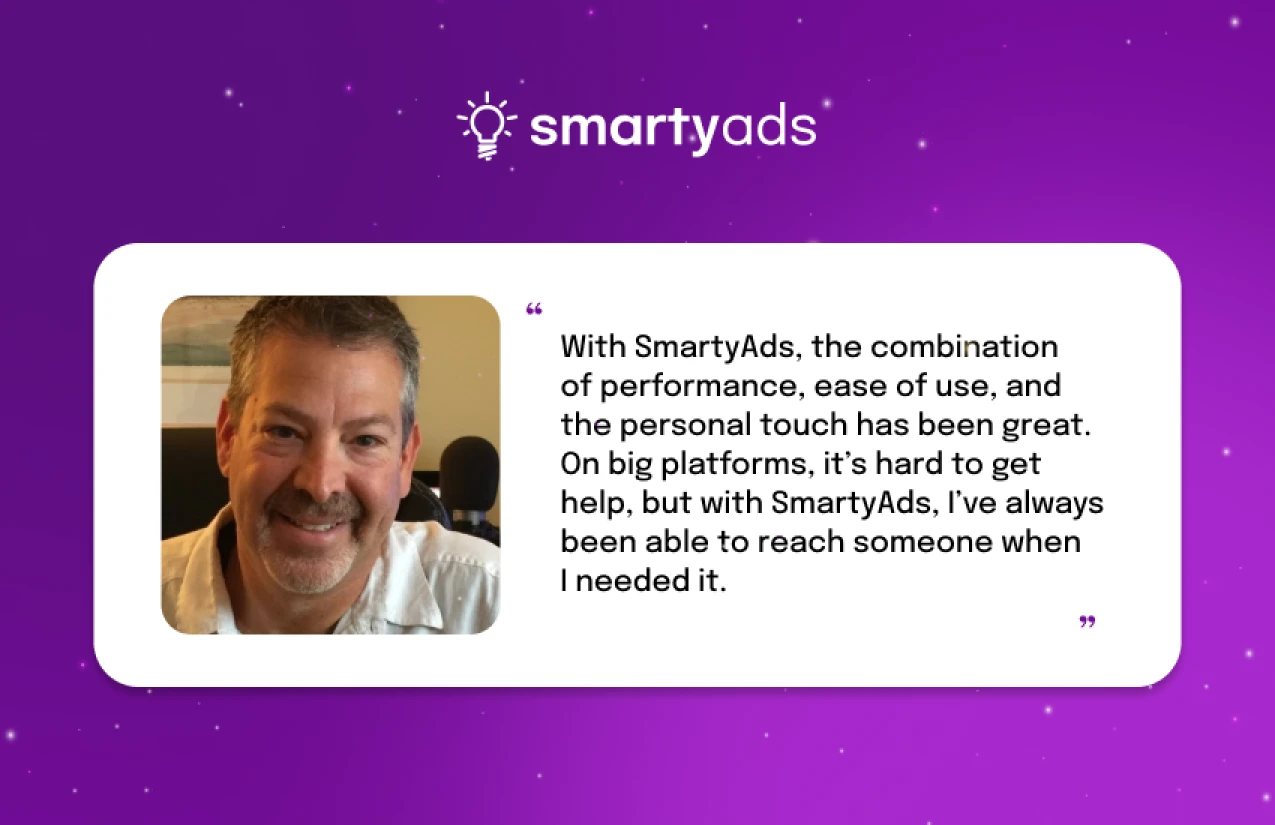
One of our collaboration cases shows that programmatic can be especially beneficial for fine-tuning geo-targeting across the client’s multi-county service. Our partner achieved ~20% Sales attribution to programmatic campaigns run on SmartyAds DSP. Read the full story.
Now, let’s review the outcomes from another collaboration:
Another case with Polina LLC showed how our partner achieved Decreasing Cost Per Install (CPI), 4.28% CTR increasing, and 2.05% conversion rate elevation in several months. This one is especially illustrative for mobile campaign purposes. Read the full story.
Moloco
 Best for: Performance marketers concerned with user acquisition.
Machine learning is the foundation upon which Moloco has made its name. It optimizes campaigns not just for installs but for users who will be able to take action after installing the software through machine learning algorithms.
As such, Moloco would appeal more to marketers trying to optimize their ads for revenue or subscriptions.
Key Features
- AI-driven bidding
- Post-install optimization
- SKAdNetwork support
- Predictive performance models
- Global inventory
Advantages
- Strong machine learning capabilities
- Excellent performance optimization
- Supports advanced user acquisition strategies
- Well suited for data-driven marketers
Limitations
- Focuses primarily on mobile rather than omnichannel advertising.
- Can have a steeper learning curve for smaller teams (self-serve platform).
Best Use Cases
- Campaigns mostly focused on performance
- Subscription-based apps
- Fintech and finance apps
- E-commerce apps optimizing for purchases
- In case you optimize for ROAS and post-install events
- Data-driven performance marketing teams
Liftoff
Best for: Mobile user acquisition and app engagement.
Liftoff is a mobile marketing platform dedicated to acquiring users that will engage with your app after installing it. Instead of being geared towards optimizing the download process alone, Liftoff aims at post-install actions, such as registration, purchase, and overall retention.
This platform is commonly employed by mobile-first companies in their efforts to acquire higher-quality users.
Key Features
- AI-powered campaign optimization
- Post-install event optimization
- Creative testing capabilities
- Fraud prevention tools
- Global in-app inventory
Advantages
- Strong focus on user quality
- Excellent optimization for engagement
- Good creative testing capabilities
- Supports iOS and Android campaigns
Limitations
- Primarily focused on mobile advertising.
- Less suitable for brands planning large omnichannel campaigns.
Best Use Cases
- Liftoff is a good fit for:
- Mobile app developers
- Subscription apps
- Shopping apps
- Lifestyle applications
- Brands focused on long-term user retention
AppLovin
 Best for: Gaming advertising and app growth.
AppLovin is currently one of the most prominent advertising platforms in the world of mobile gaming. This is because of their large selection of games and experience in working with rewarded videos.
While AppLovin offers services to all kinds of industries, gaming is where it excels.
Key Features
- Extensive gaming inventory
- Rewarded video advertising
- AI-powered optimization
- User acquisition campaigns
- Monetization tools
Advantages
- Strong presence in gaming
- Excellent rewarded ad capabilities
- Large publisher ecosystem
- Effective campaign optimization
Limitations
- Better suited for gaming than non-gaming verticals.
- Limited omnichannel functionality compared to broader DSPs.
Best Use Cases
- AppLovin works well for:
- Mobile game developers
- Casual gaming studios
- Hyper-casual publishers
- Entertainment apps
StackAdapt
 Best for: Brands seeking omnichannel advertising.
StackAdapt is a programmatic ad platform that is known for its user-friendly interface and omnichannel abilities. Although the company offers mobile ads, it enables brands to create campaigns using native, display, video, CTV, and digital audio ads from one platform.
This would be easier for brands who are moving beyond just app installs.
Key Features
- Self-service platform
- Native, display, video, and CTV inventory
- AI-powered optimization
- Audience targeting
- Advanced reporting
- Advantages
- Easy-to-use interface
- Strong omnichannel capabilities
- Detailed analytics
- Suitable for agencies and brands
Limitations
- Mobile app user acquisition is not its primary specialization. Some advanced mobile features are available, but dedicated mobile DSPs offer a more comprehensive feature set for mobile user acquisition.
Best Use Cases
StackAdapt is very suitable for:
- Omnichannel advertisers
- B2B companies
- Retail brands
- Marketing agencies
- Mid-sized businesses
Google Display & Video 360 (DV360)
 Best For: Enterprises with existing advertising operations on Google’s Marketing Platform.
Google Display & Video 360 is considered to be one of the most prominent enterprise demand-side platforms currently operating in the market space. Google Display & Video 360 enables the advertiser to gain access to a wide range of ad inventory from display, video, mobile, YouTube, and Connected TV, all integrated within Google’s marketing platform.
Key Features
- Massive global inventory
- Integration with Google Marketing Platform
- Advanced audience targeting
- Cross-channel campaign management
- Enterprise reporting
Advantages
- Excellent reach
- Powerful reporting
- Strong audience capabilities
- Suitable for global campaigns
Limitations
- Steeper learning curve than most self-service DSPs.
- Better suited for enterprise organizations with dedicated media teams.
Best Use Cases
- DV360 is a good choice for:
- Enterprise advertisers
- Global brands
- Large agencies
- Companies already using Google's advertising ecosystem
How to choose the right mobile DSP
The best DSP isn't necessarily the platform with as many features as possible. It's the one that aligns with your business goals. So, how to select among all of those options?
Before making a decision, consider the following questions.
What is your primary objective?
Different platforms excel at different goals. If you want to focus on installs, you will require robust mobile inventory as well as optimization tools. In case you are considering the development of an omnichannel approach, go for a DSP that covers more channels than mobile (and this is SmartyAds DSP).
Do you need self-service or managed support?
Some platforms are meant for experienced programmatic teams, while some others make it easy for marketers to start their own campaigns through self-service.
Which attribution methods do you use?
Ensure that the platform supports modern-day measurement tools like SKAdNetwork for iOS ads and MMP integration with your choice of partner(s).
Can the platform scale with your business?
Most advertisers usually begin with mobile marketing but eventually venture into display marketing, Connected TV advertising, digital audio, or DOOH. The selection of a DSP that has an omnichannel capability can help avoid having to move platforms in the process.
How transparent is reporting?
Detailed reporting allows marketers to know where their money is going and what optimizations work. Try to find platforms with performance metrics and insights into optimizations instead of a black box.
How easy is it to start?
Some platforms have a high threshold for joining programmatic, so it is always important to read advertiser’s agreement, policies, and info about min deposit. At SmartyADs DSP the min. The deposit for your first campaign is $1000. Joining in is as easy as:
- Register at SmartyAds DSP or request a demo.
- Create your account and fund your first ad campaign.
- Choose a mobile or in app traffic. Setup targeting and additional campaign details to instruct the platform which inventory to bid on and at which preferable price.
- Upload your creative or create it in the creative builder.
- Wait a bit until the campaign is moderated and goes live.
- Adjust the campaign and analyze (at least once per week).
Common mistakes when choosing a mobile DSP
Even experienced marketers sometimes choose platforms based on the wrong criteria.
Here are a few common mistakes to avoid:
- Choosing the lowest CPI instead of evaluating user quality.
- Ignoring privacy features.
- Looking only at inventory size instead of inventory quality.
- Overlooking fraud prevention capabilities.
- Selecting a platform that can't support future omnichannel growth.
- Avoiding these mistakes can improve both campaign efficiency and long-term return on investment.
Conclusion
Choosing an effective DSP will vary from one advertiser to another depending on their aims and needs. While some need AI optimization and performance marketing to achieve their marketing aims, others require certain special features that are not common in all platforms. If you focus on AI-powered performance marketing, there are great options such as Moloco and Liftoff, which have advanced user acquisition optimization.
Nevertheless, when advertisers want to combine usability, transparency, AI optimization, premium in-app inventory, and omnichannel approach, SmartyAds DSP can be considered a great option. It offers a self-service model through which brands and agencies can develop, manage, and optimize digital marketing campaigns using various digital channels without the help of additional buying platforms.
Grow your mobile campaigns exponentially and with ease. Create your free account on SmartyAds DSP!
FAQ
DSP in mobile marketing helps to automate the process of media buying by allowing advertisers to bid on different ad placements across different mobile environments. It helps to bid on the most suitable placements and then place the ads on those placements in real time. All is available in real-time within one dashboard.
There are plenty of options just for your needs that are adjusted just the right way: from exclusive mobile traffic to features that automatically adapt creative sizes, and offer ongoing bid optimization. SmartyAds is one of those as it has all essentials for these kinds of campaigns.
An ad network can also be used by advertisers and media buyers. These two platforms have several differences in work principles. While the network directly aggregates inventory, the DSP also connects to the numerous programmatic networks, which increases the potential inventory pool.
General one will also work for your purposes in most cases. However, if substantial part of your campaigns are in mobile and in-app, it is recommended to choose specialized. Why? Because the latest can have special access to premium in-app inventory. Also they have mobile-specific features: targeting, SKAdNetwork support and more.
Depends on the vendor. Some platforms also support omnichannel traffic (like SmartyAds DSP), and others stick only to one channel. For better possible experience, make sure to get a free consultation from a vendor that can uncover all nuances of your request.
.webp)
